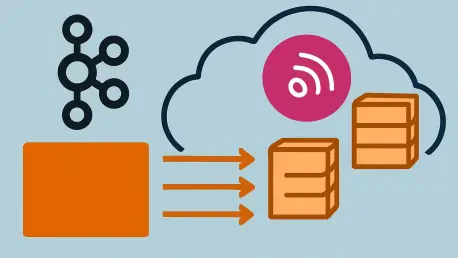

Modern distributed systems frequently grapple with the immense pressure of maintaining high-speed data integrity while ensuring that various downstream services remain loosely coupled and resilient to localized failures. As organizations transition toward more sophisticated event-driven architectures, the need for a hybrid approach that bridges high-throughput streaming with flexible, managed cloud distribution has become increasingly apparent. Apache Kafka serves as a formidable backbone for durable event logging, yet its complexity can sometimes hinder the agile distribution of specific notifications to lightweight cloud consumers. By integrating Kafka with Amazon Web Services (AWS) Simple Notification Service (SNS) and Simple Queue Service (SQS), engineering teams can effectively leverage the best of both worlds: the raw power of a distributed log and the managed elasticity of a serverless messaging ecosystem. This synergy allows for a sophisticated pipeline where data is not only stored reliably but also fanned out and queued with surgical precision across diverse cloud-native applications and services.
1. Defining the Core Architecture and Event Workflow
The fundamental strength of this integration lies in a well-defined sequential flow that ensures data moves seamlessly from its point of origin to its ultimate destination. At the start of the chain, a producer service, typically built using a framework like Spring Boot, generates a JSON-formatted event and pushes it into an Apache Kafka topic, which acts as the primary source of truth. The Kafka broker then durably persists this message, providing a reliable buffer that can handle massive spikes in traffic without overwhelming downstream systems. Because Kafka is designed for high-volume streaming, it excels at retaining these logs for extended periods, allowing multiple consumers to read the data at their own pace. This initial stage establishes a robust foundation where the system can record every state change or transaction before it undergoes further distribution into the broader cloud infrastructure.
Once the event is safely housed within the Kafka cluster, the transition to the AWS ecosystem begins through a specialized bridge service that monitors the stream. This bridge functions as a Kafka consumer, identifying specific records that require external notification and forwarding them to an AWS SNS topic. The SNS layer acts as a powerful distribution hub, using its fan-out capabilities to broadcast a single message to multiple subscribers, including one or more SQS queues. By placing an SQS queue behind the SNS topic, the architecture introduces a critical decoupling layer; even if the final consumer service is offline or under heavy load, the SQS queue holds the message until it can be processed successfully. This multi-stage workflow ensures that the high-frequency events captured by Kafka are transformed into manageable, reliable tasks that can be executed by various independent microservices without direct dependencies.
2. Constructing the Kafka Producer for Initial Streaming
Building the entry point for this pipeline requires a robust producer service that can efficiently translate application-level events into Kafka-ready records. Developers utilize the Spring for Apache Kafka library to establish a high-performance connection between the Spring Boot application and the Kafka broker, ensuring that every message is delivered with the necessary consistency guarantees. A typical implementation involves creating a REST controller or a background worker that accepts data payloads and utilizes a KafkaTemplate to dispatch them to a designated topic. The KafkaTemplate handles the low-level details of serialization and partitioning, ensuring that the JSON payload is correctly formatted and routed. This stage is crucial because it defines the schema and the initial metadata that will follow the event through the entire lifecycle, making clear documentation of the message structure a high priority for engineering teams.
In a production environment, the producer is often responsible for more than just simple data forwarding; it must also handle validation and preliminary transformations to ensure the stream remains clean. When the REST endpoint receives a POST request containing an event, the service might perform a schema check against a registry or apply business logic to determine if the message qualifies for the Kafka stream. Using an asynchronous publishing model allows the producer to return a quick success response to the client while the Kafka broker works in the background to acknowledge the write operation. This design pattern minimizes latency for the end-user and maximizes the throughput of the ingestion layer. By keeping the producer lightweight yet focused on data quality, organizations ensure that the downstream bridge and consumer services receive well-structured information that is ready for immediate processing and distribution.
3. Creating the Kafka-to-SNS Bridge for Cloud Integration
The bridge service serves as the vital connective tissue between the heavy-duty Kafka cluster and the flexible AWS messaging landscape. This component is essentially a Spring Boot application that incorporates the Spring Cloud AWS SNS integration to facilitate seamless communication with the managed cloud service. By implementing a Kafka listener, the service continuously polls the Kafka topic for new records, acting as a specialized gateway that selectively moves data across the network boundary. When a message is consumed from Kafka, the bridge uses a NotificationMessagingTemplate to publish the payload directly to an SNS topic ARN. This step is particularly effective for scenarios where a single event in Kafka needs to trigger multiple actions in the cloud, such as sending a mobile push notification, updating a database, or alerting a third-party service, all via the SNS fan-out mechanism.
Security and configuration management play a significant role in the success of this bridge layer, as it must handle credentials and resource identifiers across different environments. In a production setup, the service should ideally use IAM roles rather than static keys to authenticate with AWS, ensuring a secure and rotated access method. The bridge also provides an opportunity for filtering; instead of forwarding every single Kafka event, the service can be programmed to only pass along high-priority notifications or events that match specific criteria. This selective forwarding reduces unnecessary noise in the SNS/SQS environment and helps control cloud costs by limiting the number of messages processed. By centralizing the logic for “what goes to the cloud” in this bridge, the architecture maintains a clean separation of concerns between the internal streaming backbone and the external messaging services.
4. Configuring the SQS Consumer for Resilient Processing
The final leg of the journey involves the SQS consumer service, which is responsible for pulling messages from the queue and executing the actual business logic. This service utilizes the Spring Cloud AWS SQS integration, which provides the SqsListener annotation to simplify the consumption process by automatically handling message polling and deletion. For this stage to work optimally, the SQS queue must be correctly subscribed to the SNS topic, and the subscription should be configured with raw message delivery enabled. This setting ensures that the JSON payload arrives at the consumer in its original format, rather than being wrapped in an SNS metadata envelope. This direct access to the data allows the Spring Boot service to deserialize the JSON into a Plain Old Java Object (POJO) immediately, streamlining the transition from a raw message to actionable application data.
Resilience is built into this consumer by leveraging the inherent features of SQS, such as visibility timeouts and acknowledgement mechanisms. When the SqsListener method is invoked, the message is hidden from other consumers for a specific duration; if the logic completes successfully, the message is deleted from the queue. However, if the service encounters an error or crashes, the visibility timeout expires, and the message becomes available again for another attempt. This behavior provides a safety net that protects against data loss during transient failures or unexpected downtime. Furthermore, because SQS is a managed service, it can scale almost infinitely to accommodate large bursts of traffic forwarded from the Kafka-SNS bridge. This allows the consumer service to process events at a steady, sustainable rate, protecting the underlying business databases and external APIs from being overwhelmed by the high-velocity data stream coming from Kafka.
5. Implementing Production-Ready Reliability and Security
Transitioning a message pipeline from a development concept to a production-ready system requires a deep focus on error handling and failure isolation strategies. One of the most critical steps is the implementation of Dead Letter Queues (DLQs) for both the Kafka and SQS layers to capture and quarantine problematic messages. If a message fails to be processed after a predetermined number of retries, it is moved to the DLQ, where engineers can inspect it without blocking the rest of the pipeline. This approach prevents “poison pill” messages from stalling the entire system and provides a clear audit trail for debugging. Additionally, implementing idempotency is non-negotiable in production; since both Kafka and SQS may deliver a message more than once under certain failure conditions, the consumer must use unique event IDs to ensure that a single transaction is not processed multiple times.
Security and observability represent the final pillars of a mature production environment, ensuring the system remains both safe and transparent. Utilizing IAM roles for service-to-service communication within AWS eliminates the risks associated with managing long-lived credentials, while encrypted topics and queues protect sensitive data at rest and in transit. On the observability front, integrating AWS CloudWatch with Kafka metrics provides a unified view of the system’s health, from the ingestion rate at the producer to the lag in the final SQS consumer. By including correlation IDs in the message headers at the producer level, teams can trace the path of a single event across all microservices, making it much easier to identify bottlenecks or failures in the distributed chain. These best practices collectively transform a simple data bridge into a high-availability infrastructure capable of supporting mission-critical enterprise workloads.
6. Advancing the Pipeline with Future Considerations
The combination of Apache Kafka and AWS messaging services provided a sophisticated solution for complex event-driven challenges in previous architectural iterations. Moving forward, the focus shifted toward optimizing these integrations by exploring managed services like Amazon MSK to reduce the operational overhead of maintaining Kafka clusters manually. This transition allowed engineering teams to spend less time on infrastructure patching and more time on refining the business logic within the bridge and consumer services. Furthermore, the adoption of serverless compute options, such as AWS Lambda, for the bridge layer replaced traditional long-running Spring Boot instances in many scenarios. This change offered a more cost-effective “pay-per-invocation” model, particularly for sporadic or unpredictable traffic patterns where maintaining a dedicated server would have been inefficient.
The journey toward a fully resilient system reached its peak as developers integrated advanced tracing tools and automated recovery protocols into the pipeline. Organizations began utilizing schema registries to enforce strict data contracts between Kafka producers and SQS consumers, preventing breaking changes from disrupting the flow of information across the bridge. Additionally, the move toward FIFO (First-In-First-Out) configurations for SNS and SQS addressed the long-standing challenge of message ordering, which was essential for financial transactions and state-dependent updates. These advancements ensured that the hybrid messaging stack remained the gold standard for reliability and scalability. By grounding the architecture in these specialized services, teams successfully navigated the complexities of modern data distribution, creating a future-proof foundation that balanced high-performance streaming with the flexibility of cloud-native messaging.