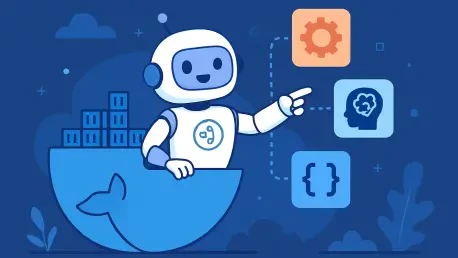

The traditional struggle of maintaining complex Python environments and tangled dependency chains is finally giving way to a more streamlined approach where AI agents operate as standard, portable containers. For years, the integration of autonomous agents into production systems felt like a high-stakes gamble with library versions and runtime conflicts. By encapsulating the entire reasoning engine within a container, Docker ensures that an agent behaving correctly on a developer’s laptop will perform identically in a high-scale cloud environment. This shift toward “Agentic Portability” treats intelligence as a plug-and-play component rather than a fragile, machine-specific script.
As the industry moves away from code-heavy orchestration, the focus has shifted to refining the behavior and persona of the AI rather than the plumbing that keeps it running. Developers no longer need to spend dozens of hours wrestling with environment variables or complex orchestration logic just to see a basic prototype in action. Instead, the focus is now on the actual utility the agent provides to the end-user. This container-first mentality ensures that the deployment of an AI agent is as predictable and reliable as the deployment of a simple web server or a microservice.
The Shift: From Code-Heavy Orchestration to Containerized Intelligence
The transition away from manual environment management represents a significant milestone in the broader software engineering timeline. The historical reliance on sprawling boilerplate code has often acted as a barrier to entry for many generalist developers who want to leverage the power of large language models. By simplifying the packaging process, Docker allows teams to treat AI agents as standard units of software that follow the same lifecycle as any other application. This modularity means that an agentic workflow can be tested, versioned, and rolled back with the same precision as a traditional software update.
Furthermore, the move toward containerized intelligence addresses the inherent instability found in many modern AI development stacks. When dependencies are pinned within a Docker image, the risk of a breaking change in an external library crashing the agent is significantly mitigated. This creates a more robust foundation for enterprise-grade applications where reliability is non-negotiable. Consequently, the conversation has moved from how to run an agent to how to best utilize its specialized capabilities to solve real-world business problems.
Understanding the Need: Declarative AI Frameworks
Standardization has always been the catalyst for mass adoption in technology, yet the current AI landscape often resembles the pre-container era of fragmented server configurations. Developers frequently find themselves trapped in an overhead trap where the code required to manage the agent exceeds the code defining its actual utility. Traditional programmatic frameworks require deep specialized knowledge, which creates a bottleneck for teams wanting to deploy simple automated helpers. These models often lead to rigid architectures that are difficult to modify once the initial development phase is complete.
Cagent addresses these challenges by using the existing Docker ecosystem to democratize the creation of autonomous tools for every engineer, regardless of their background in data science. By moving toward a declarative model, the framework allows for a separation of concerns between the logic of the AI and the infrastructure it occupies. This approach bridges the skills gap between specialized AI researchers and generalist software engineers, allowing more people to contribute to the development of intelligent systems. It effectively transforms AI development into a standard DevOps workflow that fits naturally into existing CI/CD pipelines.
Core Capabilities: The YAML-First Philosophy
At the heart of this new framework is a commitment to simplicity through a configuration-first design philosophy. Instead of writing hundreds of lines of Python to define a persona or a set of instructions, developers now utilize a single YAML file to outline specific constraints, models, and capabilities. This approach separates the underlying logic of the language model from the execution infrastructure, allowing for faster iterations and much easier debugging. It empowers developers to define the “what” of an agent rather than the “how,” leading to cleaner and more maintainable codebases.
Integration with the Model Context Protocol further extends this utility by providing a standardized bridge to external data sources without the need for custom API wrappers. Whether an agent needs to access a local filesystem, a secure database, or a third-party search engine, the protocol handles the handshake and data transfer seamlessly. Moreover, the Docker Model Runner serves as a vendor-agnostic backend, ensuring that developers are not locked into a single provider. This flexibility allows for a mix-and-match approach where the best model for a specific task can be selected without rewriting the entire agentic logic.
Scalability: Multi-Agent Workflows
Complexity in AI often arises when a single model is expected to handle too many diverse tasks simultaneously, leading to degraded performance. Cagent solves this by facilitating multi-agent workflows where a central “Root” manager delegates specialized duties to various “Sub-agent” specialists. This hierarchical orchestration model ensures that a research specialist does not interfere with a code generation specialist, maintaining high-quality output through strict modularity. The root agent acts as the sole point of contact for the user, managing the internal complexity and presenting a unified response.
This encapsulated reasoning allows for sophisticated problem-solving where specialists perform deep-dive tasks in isolation before reporting their findings back to the manager. Because these agents are essentially Docker images, they can be versioned and distributed across organizations via the Docker Hub registry. This creates a collaborative environment where teams can share pre-configured specialists for common tasks, such as documentation writing or security auditing. The ability to push and pull agent configurations just like container images represents a new frontier in collaborative AI development.
Practical Implementation: From Setup to Deployment
Setting up a local environment for Cagent is a straightforward process that requires only the latest version of Docker Desktop or a simple CLI installation via common package managers. Once the prerequisites are met, the workflow involves defining a persona, selecting a model, and assigning specific tools for tasks like file manipulation or memory retention. The declarative nature of the configuration means that even complex agents can be described in a few dozen lines of text. This drastically reduces the time from initial concept to a functioning, production-ready AI worker that can interact via a terminal.
Implementing practical toolsets like filesystem access or shell execution allows the agent to perform real work on a local machine or server. For example, a specialized technical writer agent can be configured to read documentation from a directory, process it through an LLM, and then write a summarized report back to the disk. These actions are performed within the safety of a containerized environment, providing a layer of security and isolation. The simple execution command initializes the container and starts the reasoning loop, making the agent immediately available for task delegation and interactive conversation.
The introduction of Cagent provided a clear path toward the commoditization of AI agents within the standard development lifecycle. It eliminated the technical debt often associated with early-stage AI experimentation and allowed organizations to focus on the strategic implementation of autonomous tools. Moving forward, the industry benefited from treating these agents as modular units of work that could be easily audited, shared, and updated across diverse teams. Developers who embraced this declarative model positioned themselves to build more resilient and scalable intelligent systems without the burden of legacy orchestration methods. This shift essentially turned the complex art of AI agent creation into a reproducible and accessible engineering discipline.