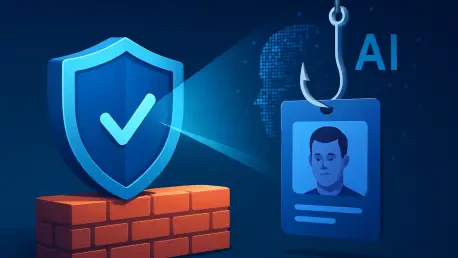

Imagine receiving an urgent voice message from your chief executive officer, her tone strained with urgency, instructing you to immediately wire a large sum of money to a new vendor to close a critical, time-sensitive deal. The voice is unmistakably hers, the context is plausible, and the pressure is immense; however, the entire request is a sophisticated fabrication, generated by artificial intelligence to exploit trust and bypass security protocols. This scenario is no longer science fiction; it is the new reality of Phishing 3.0, a landscape where AI and deepfakes have transformed social engineering from a game of chance into a precision-guided weapon. In this elevated threat environment, traditional email security measures, once the bedrock of corporate defense, are proving dangerously insufficient. The evolution of these attacks necessitates a fundamental rethinking of security, moving toward a layered strategy that integrates advanced technology, robust processes, and a highly aware human firewall.
The High Stakes of Phishing 3.0 Assessing the Business Impact
Defending against this new wave of hyper-realistic phishing attacks is not merely an IT challenge but a fundamental imperative for business continuity and market trust. The consequences of a successful breach extend far beyond a single compromised account, creating cascading failures that can cripple an organization. A successful attack can unravel years of brand building in an instant, proving that the greatest vulnerability often lies in the implicit trust employees place in their communications. Consequently, understanding the full spectrum of potential damage is the first step toward building a truly resilient defense.
The most immediate and tangible consequence is direct financial loss. Attackers leveraging AI can craft flawless business email compromise (BEC) campaigns that trick finance departments into executing fraudulent wire transfers. Beyond direct theft, these attacks are often a gateway for deploying ransomware, which can paralyze entire networks and lead to exorbitant recovery costs. Simultaneously, the theft of sensitive data, such as intellectual property or customer information, can result in long-term competitive disadvantage and financial harm. This is compounded by severe reputational damage; when a breach becomes public, the loss of customer and partner trust can be devastating and far more costly to repair than the initial financial loss.
Furthermore, a successful AI-driven phishing attack can plunge an organization into a regulatory and legal quagmire. Data protection regulations like the General Data Protection Regulation (GDPR), the Health Insurance Portability and Accountability Act (HIPAA), and the Payment Card Industry Data Security Standard (PCI DSS) impose stringent requirements for safeguarding sensitive information. A breach resulting from inadequate security can trigger massive fines, class-action lawsuits, and mandatory public disclosures that amplify reputational harm. Operationally, the impact is just as severe. Stolen credentials provide attackers with an insider’s level of access, enabling them to disrupt critical infrastructure, cause system outages, and compromise core business functions, leading to prolonged downtime and significant operational paralysis.
A Multi Layered Strategy for Enterprise Phishing Defense
In the face of such sophisticated threats, a single-minded reliance on any one security tool is a recipe for failure. The only effective countermeasure is a cohesive, multi-layered strategy that weaves together advanced technology, proactive policies, and a deeply ingrained culture of security awareness. This approach creates a defense-in-depth model where each layer is designed to detect, delay, or defeat an attack, ensuring that if one control fails, another is in place to stop the threat. Each component plays a distinct but interconnected role in neutralizing the advanced social engineering tactics at the heart of Phishing 3.0.
Understand the Threat How AI Supercharges Social Engineering
Building a formidable defense begins with a clear and comprehensive understanding of the enemy’s tactics. AI has fundamentally changed the game for attackers, granting them the ability to automate and scale attacks with a level of personalization and polish that was once impossible. What formerly required significant time and manual effort can now be executed in minutes, allowing adversaries to launch highly targeted campaigns against thousands of individuals simultaneously. This automation eliminates the classic red flags—such as poor grammar or generic greetings—that once made phishing emails relatively easy to spot, making the threat far more insidious.
Generative AI tools and malicious large language models (LLMs), such as WormGPT, have become a cornerstone of modern phishing campaigns. These platforms are purpose-built to craft flawless, contextually aware emails that mimic a target’s communication style with uncanny accuracy. By scraping public data from sources like LinkedIn, company websites, and social media, these systems can generate highly personalized messages that reference specific projects, colleagues, or recent events, making them appear completely legitimate. This capability allows attackers to automate spear phishing at a scale previously unimaginable, turning a once-specialized attack into a common threat vector that bypasses both technological filters and basic human scrutiny.
Perhaps the most alarming development is the use of deepfake technology in BEC and other impersonation attacks. Attackers can now use AI to clone an executive’s voice from just a few seconds of audio or create a realistic video avatar for live calls on platforms like Zoom and Teams. A common scenario involves a finance employee receiving a video call from a deepfake of their CEO, who uses urgency and authority to pressure them into bypassing established protocols for an emergency wire transfer. These attacks are profoundly effective because they exploit the core human elements of trust and obedience to authority, making employees question their own judgment in the face of what appears to be a direct order from a superior.
Implement Advanced Technical Controls
As attackers weaponize AI, organizations must respond in kind by deploying technical controls that can detect and block threats designed to evade traditional security filters. Legacy systems that rely on known signatures and static rules are simply no match for AI-generated attacks that are often unique to each target and have no previously identified fingerprint. The new generation of security solutions must move beyond simple filtering and embrace a more intelligent, adaptive approach to identifying malicious content and behavior.
The most effective way to counter AI-driven attacks is by fighting AI with AI. Modern, AI-powered security platforms employ anomaly-based detection to build a sophisticated behavioral baseline for every user and the organization as a whole. These systems analyze countless data points in real-time, including communication patterns, sender-recipient relationships, linguistic style, and the time and location of requests. When a communication deviates from this established norm—for instance, an executive suddenly emailing from an unfamiliar location with an uncharacteristically urgent financial request—the system flags it as a high-risk anomaly, even if the message itself contains no malicious payload. This allows for the detection of sophisticated social engineering attempts that would appear perfectly benign to a traditional email gateway.
Since the primary objective of many phishing campaigns is to steal credentials, a critical defensive layer involves neutralizing the value of those stolen passwords. Adopting a Zero Trust security model, which operates on the principle of “never trust, always verify,” is essential. This framework assumes that threats can exist both inside and outside the network, and therefore requires strict verification for every user and device attempting to access resources. The cornerstone of this model is the enforcement of robust Multi-Factor Authentication (MFA). By requiring a second form of verification, such as a code from a mobile app or a biometric scan, MFA ensures that a compromised password alone is not enough to grant an attacker access, effectively shutting down the primary pathway for account takeovers.
Fortify Your Human Defenses
While technology provides a powerful shield, it is not infallible. The most cunning social engineering attacks are designed to bypass technical controls and target the person at the keyboard. For this reason, employees must be viewed not as a liability but as a critical and final layer of defense. A well-informed and vigilant workforce, empowered with the right knowledge and procedures, can often spot and stop a sophisticated attack that technology might miss. Fortifying this human firewall is a non-negotiable component of any serious defense against Phishing 3.0.
Security awareness training must evolve beyond a simple annual presentation on spotting suspicious links. To be effective, training programs must now incorporate modules specifically designed to educate employees on the nuances of AI-driven threats. This includes teaching them to recognize the subtle artifacts of deepfake video, such as unnatural eye movements or odd lighting, and to be skeptical of voice calls that convey extreme urgency without prior context. Phishing simulations should also be modernized to include not only email-based tests but also vishing (voice phishing) and smishing (SMS phishing) scenarios that mirror the multi-channel nature of modern attacks. Continuous, engaging, and relevant training transforms employees from potential victims into active defenders.
Awareness, however, is insufficient without clear, actionable protocols for employees to follow when they encounter a suspicious request. Organizations must establish and relentlessly communicate simple, unambiguous incident response procedures. For example, a non-negotiable policy should mandate that any unusual or urgent request for a financial transaction, data access, or credential change must be verified through an out-of-band channel. This means if an employee receives a suspicious email from their manager, they should not reply to it but instead contact the manager through a trusted, separate method, such as a known phone number or a different messaging platform, to confirm the request’s legitimacy. This simple step creates a procedural roadblock that can thwart even the most convincing deepfake or BEC attempt.
Conclusion A Proactive Stance in the AI Arms Race
The evidence presented demonstrated that AI-driven phishing and deepfake attacks were not a future concern but a clear and escalating danger that has already rendered reactive security postures obsolete. Traditional defenses, which were built to recognize known threats, were proven to be fundamentally unequipped to handle the dynamic, personalized, and scalable attacks generated by modern AI. The era of passive cyber defense has definitively ended.
The analysis of these evolving threats led to an unavoidable conclusion: enterprises of all sizes were required to adopt a proactive and deeply layered security posture to ensure their survival. This strategic shift was not presented as a mere recommendation but as a foundational business necessity. The speed and sophistication of Phishing 3.0 campaigns showed that organizations that failed to adapt would inevitably fall behind, leaving themselves exposed to catastrophic financial, reputational, and operational damage.
Ultimately, the most resilient organizations were identified as those that successfully integrated three core pillars into a unified defense. They fused AI-powered technology to combat automation with superior automation, implemented robust processes that created friction for attackers, and fostered continuous employee education to empower their human firewall. This synthesis of advanced tools, intelligent policies, and human vigilance was established as the definitive strategy for staying ahead in the escalating cybersecurity arms race.