
The most brilliant network architects in the industry are spending their days diagnosing routine outages instead of designing the secure, resilient infrastructures of tomorrow, a silent crisis hamstringing technological progress at its very core. As enterprises deploy increasingly complex zero-trust networks, the operational teams tasked with maintaining them are falling behind, creating a critical skills gap between system design and daily reality. This chasm forces senior engineers into a perpetual state of reactive fire-fighting, diverting their expertise from innovation to incident response. The crucial question now is not whether this problem exists, but whether a new generation of AI-driven automation can provide the definitive solution.
When Senior Architects Become First Responders
In many organizations, the most experienced systems engineers have become the default first responders for network incidents. These are the individuals who designed the intricate, multi-layered security architectures, and consequently, they are often the only ones with the deep contextual knowledge required to troubleshoot them effectively. This creates a critical operational bottleneck, where progress on strategic projects halts every time a complex but solvable problem arises in the live environment. The reliance on this small group of experts for day-to-day operations is not a sustainable model; it stifles innovation, burns out top talent, and leaves the organization vulnerable.
The root of this issue lies in the growing disconnect between systems engineering and operations. While engineering teams build sophisticated, next-generation networks, operations teams are frequently left with outdated procedural documents that fail to capture the nuances of the new architecture. When an unfamiliar error code appears, the standard runbook offers no guidance, leaving escalation as the only viable path. This transforms senior architects from designers into a high-cost, overqualified support tier, a role that undermines their primary function and the strategic goals of the enterprise.
The Widening Chasm Between Design and Daily Operations
Modern network environments are exponentially more complex than their predecessors. The push toward zero-trust principles, micro-segmentation, and cloud-native infrastructure generates a torrent of data, logs, and alerts that can easily overwhelm human operators. Each new technology adds another layer of abstraction and another potential point of failure, making a holistic understanding of the system nearly impossible for anyone outside the original design team. This complexity is the primary driver of the operational skills gap, creating a scenario where the network’s sophistication outpaces the organization’s ability to manage it.
This widening chasm is a problem that traditional training and hiring practices cannot solve alone. It is impractical to expect every member of a network operations center to possess the same level of expertise as a senior architect. The time and resources required for such extensive upskilling are prohibitive. As a result, organizations find themselves with a robust network on paper that is operationally fragile in practice, entirely dependent on the availability of a few key individuals. The challenge is no longer just about finding skilled people; it is about embedding that skill into the operational framework itself.
An Architectural Blueprint for Autonomous Network Operations
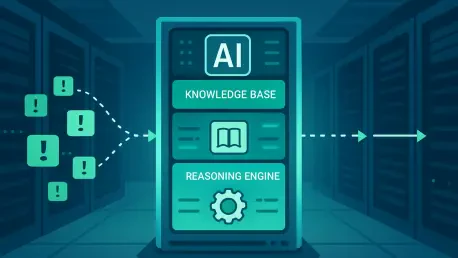
To address this systemic challenge, a new architectural pattern has emerged: a framework for an AI-powered operations support system. This is not merely a chatbot or a dashboard but a cohesive, four-part architecture designed to function as an autonomous extension of the engineering team. The first component is a curated knowledge base, a single source of truth built from technical vendor manuals, historical incident reports, and detailed network topology information. By structuring this data, for instance by converting raw text from PDFs into machine-readable formats, it becomes the foundational context that fuels the system’s intelligence.
At the heart of this architecture lies the reasoning layer, a Retrieval-Augmented Generation (RAG) AI engine. When an alert is ingested, this engine queries the knowledge base to retrieve relevant context, such as the precise meaning of a proprietary error code. It then provides this curated information to a Large Language Model (LLM), which reasons through the problem to identify the appropriate remedial action, much like a senior engineer would. This step is seamlessly connected to an integration workflow that functions as an event-driven pipeline, automating the entire process from log ingestion to final resolution without human intervention.
To counter the inherent risk of AI hallucination, where a model might generate a harmful or nonexistent command, a critical safety component is introduced: the auto-remediation executor. This module operates on a “deterministic executor pattern,” strictly separating the AI’s role from the execution. The AI’s job is limited to selecting the intent for a fix. The actual execution is handled by a library of pre-written, thoroughly vetted Python scripts. This design ensures that the system only performs safe, pre-approved actions on the network, providing an enterprise-grade safety net that makes true automation feasible.
A Case Study in Speed and Accuracy
The theoretical advantages of this AI-driven model have been validated in real-world applications, demonstrating a dramatic impact on both accuracy and efficiency. In a controlled implementation, the system was tasked with interpreting obscure, proprietary error codes that frequently stumped junior operators. By restricting the AI’s reasoning to the context provided by its curated vector database of vendor manuals, it achieved 100% accuracy in identifying the root cause of these alerts, eliminating guesswork and the potential for human error.
This precision translated directly into a quantum leap in operational speed. The manual process, which involved a Tier-1 operator identifying an alert, searching for documentation, and potentially escalating to a senior engineer, averaged a 15-minute time-to-remediation. In stark contrast, the automated AI-ops pipeline completed the entire cycle—from log ingestion and analysis to executing the correct remediation script—in just 16 seconds. This near-instantaneous response not only resolves issues faster but also prevents minor problems from cascading into major outages.
The New Playbook for Network Operations
This architectural shift signals a fundamental change in NetOps strategy, moving away from a reliance on endless training and toward a model of encoded expertise. The goal is no longer to make every junior engineer a senior architect but to build agentic workflows that encapsulate senior-level knowledge into reliable, 24/7 automated systems. By wrapping the reasoning capabilities of LLMs within the safety of deterministic Python functions, organizations can create truly self-diagnosing and self-healing networks that operate with a level of safety and efficiency previously unattainable.
This evolution ultimately redefined the role of the human operator within the network operations center. With AI handling the bulk of routine diagnostics and remediation, Tier-1 operators are empowered to resolve issues that once required Tier-3 escalation, dramatically increasing their effectiveness and job satisfaction. More importantly, it liberated senior architects from the relentless cycle of support tickets, allowing them to reclaim their primary role as innovators. By successfully closing the skills gap, AI automation did not replace engineers but rather elevated them, allowing them to focus on designing the resilient, forward-looking networks that will power the enterprise of the future.