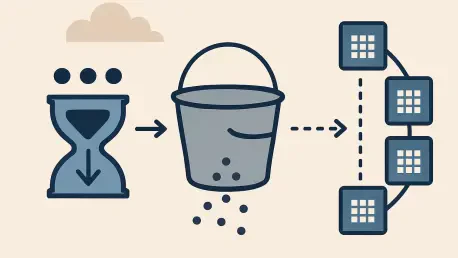

A single millisecond of desynchronization within a high-traffic microservice architecture frequently dictates whether a platform remains operational or collapses under the weight of a cascading system failure. When thousands of requests pour into a distributed cluster every second, the challenge of maintaining an accurate count of available resources becomes a battle against the laws of physics and network latency. Traditional synchronization methods often force an uncomfortable choice between absolute precision and the rapid response times that modern users demand. In this high-stakes environment, the ability to enforce global limits without a centralized bottleneck is no longer a luxury; it is a foundational requirement for digital resilience.
The importance of this technical synergy lies in its ability to solve the “double-spend” problem at scale. As organizations move toward increasingly fragmented cloud-native environments, the traditional reliance on a single, centralized database for state management has become a liability. By integrating Bucket4j with Embedded Infinispan, engineers can now deploy a peer-to-peer data grid that lives directly within the application JVM, effectively turning every node into a guardian of the system’s integrity. This shift represents a fundamental evolution in how state is synchronized across distributed systems, offering a path to linear scalability that avoids the performance tax of external infrastructure.
The High Cost: A Distributed Double-Spend
In the world of distributed computing, the “double-spend” problem occurs when two separate application pods simultaneously check a stale counter and both conclude that they are authorized to grant access to a request. This desynchronization typically happens when a system lacks a single source of truth that can be updated with atomic precision. If a global rate limit is set at one hundred requests per second, but three different nodes each believe they have five tokens remaining due to a slight delay in synchronization, the system could inadvertently allow fifteen requests. While this might seem like a minor discrepancy in isolation, at a massive scale, these inaccuracies accumulate into a tidal wave of traffic that can overwhelm downstream services and trigger a total system outage.
The financial and operational repercussions of failing to maintain atomic consistency are significant. When a rate limiter fails to accurately throttle traffic, the resulting surge can lead to increased infrastructure costs, violated service-level agreements, and a degraded user experience. Furthermore, debugging these transient race conditions is notoriously difficult, as they often disappear under lower load or during synthetic testing. Engineers are left chasing “ghosts” in the machine—errors that only manifest when the cluster is under the exact right amount of pressure. This unpredictability necessitates a shift away from “eventual consistency” models toward a more robust, atomic framework that guarantees every token is accounted for in real time.
Solving the State Synchronization DilemmModern Clusters
As applications have shifted toward containerized environments like Kubernetes, the task of managing “state” has become the primary engineering hurdle. A local, memory-based bucket is no longer sufficient because a single pod lacks awareness of what its peers are doing. Conversely, relying on a central database like Postgres or a shared Redis cluster introduces a round-trip network hop for every incoming request, creating a performance bottleneck that grows more severe as the cluster expands. This dilemma forces a search for a third option: a synchronization layer that is distributed enough to scale horizontally but local enough to maintain the low-latency characteristics of an in-memory solution.
The integration of Bucket4j with Embedded Infinispan provides exactly this middle ground by creating a self-contained synchronization layer. Instead of reaching out to a remote server, the application uses Infinispan to form a data grid among the pods themselves. This peer-to-peer architecture allows the state of the rate limiter to reside in the shared memory of the cluster. As new nodes are added to handle increased traffic, the data grid automatically redistributes the keys, ensuring that the burden of state management is shared equally. This approach eliminates the need for expensive external infrastructure, simplifying the deployment pipeline and reducing the number of moving parts that can fail during a production incident.
Core Mechanisms: The Bucket4j and Infinispan Integration
The technical elegance of this integration resides in the way Bucket4j abstracts the logic of rate limiting while Infinispan handles the complexities of distributed storage. Bucket4j utilizes a Proxy Manager abstraction, which serves as a specialized interface that decouples the “how” of token consumption from the “where” of the data storage. When a request to consume a token is initiated, the Proxy Manager does not simply send a raw value to the grid. Instead, it encapsulates the entire operation into a remote command. This command is then handed off to Infinispan, which serves as the distributed backbone of the operation, ensuring that the rules of the bucket are applied consistently across every node in the cluster.
Infinispan facilitates this process through its Functional Map API and the use of a ReadWriteMap. This is a departure from the traditional “get-update-put” cycle, which is inherently vulnerable to race conditions where two threads might read the same value before either has had a chance to update it. Instead, this setup employs an “Entry Processor” model. The application ships the logic—expressed as a lambda function—directly to the specific cluster node that owns the data for a given key. This means that the token count is updated locally on the node where it resides, and the operation is completed within a single locked transaction. By moving the logic to the data rather than pulling the data to the logic, the system achieves a level of atomic precision that traditional key-value stores struggle to match.
Technical Nuances: Data Locality and Atomic Consistency
Expertly implementing this pattern requires a conceptual shift toward the principle of “moving logic, not data.” In a typical distributed setup, data is frequently serialized, sent over the wire, deserialized, modified, and then sent back. This cycle is a primary killer of performance because it consumes CPU cycles and consumes network bandwidth. By leveraging consistent hashing, Infinispan identifies which node in the cluster is the primary owner of a specific bucket key—such as a specific User ID or an API key. The rate-limiting command is sent only to that node, where it executes against the local memory. This minimizes the footprint of each request and ensures that the network is used only to transmit the result of the operation rather than the entire state of the bucket.
However, this high degree of optimization introduces a critical requirement: the cluster must remain perfectly homogeneous. Because the system passes serializable functions between nodes, every pod in the environment must be running the exact same version of the application bytecode. If a rolling update is handled improperly, a newer pod might send a function that an older pod cannot understand, leading to a cascade of deserialization errors. To maintain production stability, deployment strategies must ensure that all nodes are synchronized not just in their data, but in their logic as well. This level of operational discipline is the price of achieving the extreme low latency and high throughput that this architecture provides, making it a favorite for teams that prioritize precision over simplicity.
Implementation Strategies: High-Performance Rate Limiting
To successfully deploy an atomic rate-limiting layer, developers should adopt a non-blocking, asynchronous framework. By utilizing the AsyncBucketProxy, the application can remain fully responsive even as it waits for the cluster to confirm a token consumption. The application does not sit idle; instead, it handles the CompletableFuture returned by the Infinispan Functional Map API, allowing it to process other tasks while the data grid performs the atomic update. This asynchronous flow is vital for maintaining high throughput in modern, reactive microservices where thread efficiency is paramount. A blocking call in a high-concurrency environment can quickly lead to thread pool exhaustion, turning a slight delay in the data grid into a full-scale application hang.
A crucial technical step in the setup involves the configuration of the InfinispanProxyManager and the specialized Bucket4jProtobufContextInitializer. These components handle the conversion of bucket states into optimized byte streams, ensuring that the data being moved across the cluster is as lean as possible. On the data-owning node, a binary transaction wrapper manages the state retrieval and command execution within a single atomic round trip. This framework effectively bridges the gap between the speed of local execution and the consistency of a distributed system. By carefully managing how the state is serialized and ensuring that transactions are kept as short as possible, developers can create a defense layer that is robust enough to handle the most aggressive traffic surges without buckling under the pressure of synchronization overhead.
As the landscape of microservices continued to evolve, the integration of these two technologies proved to be a decisive factor in stabilizing the volatile traffic patterns of the mid-2020s. Engineers moved away from the fragility of centralized counters and embraced the resilience of distributed data grids that resided within their own JVMs. This transition allowed for a more granular control over resource allocation, as the logic for rate limiting was no longer a distant service but an intrinsic part of the application’s own memory space. The focus then shifted toward the refinement of serialization protocols and the optimization of consistent hashing algorithms to further shave microseconds off the response times.
The adoption of this architecture necessitated a more rigorous approach to deployment cycles and versioning, as the serialized nature of the entry processors demanded absolute uniformity across the cluster. Teams that mastered this synchronization avoided the pitfalls of the double-spend problem and built systems that scaled linearly with their user base. Looking ahead, the principles established by this integration suggest a future where the boundary between application logic and data storage becomes even more blurred. Developers began exploring ways to embed more complex state machines directly into these distributed grids, paving the way for a new generation of autonomous, self-throttling services that maintain equilibrium without the need for manual intervention or external orchestration.