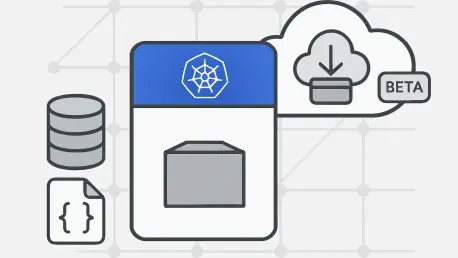

Managing static data and configurations within Kubernetes has often felt like a cumbersome necessity, frequently requiring engineers to juggle external storage services, complex permission models, and separate deployment pipelines. This approach introduces operational friction and potential security gaps, complicating the otherwise streamlined world of container orchestration. However, a significant shift is underway with the introduction of a native Kubernetes feature: the image volume. This innovative volume type, currently in beta since version 1.35.0, allows standard OCI images to be mounted directly as volumes, promising to revolutionize how data is packaged, distributed, and consumed within cloud-native environments. This integration signals a move toward a more unified, secure, and efficient ecosystem where data and configurations are treated as first-class citizens alongside application code.
1. A New Paradigm for Infrastructure and Security
The adoption of OCI images for data management presents a fundamental change in how organizations architect their cloud-native infrastructure, moving away from fragmented, external dependencies toward a more cohesive and integrated model. Previously, handling static assets like machine learning models, website content, or complex configuration files necessitated provisioning and maintaining external storage solutions such as Amazon S3 or Google Cloud Storage. This process involved not only direct financial costs but also significant operational overhead, including managing access control policies, ensuring network connectivity from the cluster, and handling potential latency issues. By leveraging the image volume, this entire layer of complexity is abstracted away. The container registry, an existing and integral part of the CI/CD pipeline, now serves as a unified repository for both application binaries and their associated data. This consolidation simplifies the architecture, reduces the attack surface by eliminating an external integration point, and lowers the cognitive load on development teams, allowing them to focus on application logic rather than infrastructure management.
This shift toward using OCI images as data volumes also introduces a powerful and much-needed enhancement to the security posture of Kubernetes applications. In traditional workflows, configuration files and static data pulled from external sources often represented a security blind spot. These assets were typically not subjected to the same rigorous scanning and validation processes as application container images, potentially allowing vulnerabilities or misconfigurations to go undetected. With the image volume, data is packaged within a standard OCI image, making it fully compatible with existing container security tools. This means that data images can be seamlessly integrated into the security pipeline and scanned for known vulnerabilities, malware, or exposed secrets using the same scanners that protect application code. This practice of “security by design” ensures that every component deployed into the cluster, whether code or data, adheres to the same high standard of security, effectively closing a long-standing gap in cloud-native security practices and promoting a more resilient and trustworthy system.
2. Accelerating Development and Aligning with Industry Trends
Beyond the infrastructure and security benefits, the separation of data from application code enabled by OCI image volumes directly translates into increased developer velocity and more agile deployment workflows. In a monolithic approach where configurations are baked into the application image, even the smallest change—such as updating a feature flag or modifying a UI theme—requires a complete rebuild, re-testing, and redeployment of the entire application. This process can be time-consuming and inefficient, especially in large-scale microservices environments. By packaging data and configurations into separate, lightweight OCI images, teams can update them independently of the application code. This decoupling allows for much faster iteration cycles. For instance, a data science team can publish a new version of a machine learning model, or a UI team can release new static assets, simply by pushing a new data image to the registry. The corresponding application pods can then be updated with a simple rolling update to mount the new image version, a process that is significantly faster and less disruptive than a full application redeployment.
The native implementation of image volumes in Kubernetes is not an isolated innovation but rather an official endorsement of a pattern that has already gained significant traction across the cloud-native ecosystem. Leading open-source tools have been pioneering this approach for some time, demonstrating its practical value in real-world scenarios. For example, the security tool Falco distributes its detection rules as OCI images, allowing users to easily pull and apply updated rule sets. Similarly, the policy engine Kyverno packages its policies in OCI images, simplifying policy management and distribution across clusters. In the GitOps domain, FluxCD leverages this pattern to manage deployment configurations, further proving the model’s versatility. By incorporating this capability directly into its core, Kubernetes is not just introducing a new feature; it is standardizing an industry best practice. This alignment provides a consistent and familiar experience for developers and operators, reducing the learning curve and ensuring that the platform evolves in lockstep with the needs and innovations of the wider community.
An Evolved Approach to Data Integrity
The integration of OCI image volumes into Kubernetes ultimately represented a pivotal moment in the platform’s evolution. It addressed long-standing challenges related to the management of static data and configurations by providing a solution that was not only elegant in its simplicity but also deeply integrated with the existing cloud-native toolchain. This move streamlined complex architectures by centralizing assets within the container registry, thereby reducing reliance on external storage systems and their associated operational burdens. More importantly, it elevated the security and agility of deployments, allowing for independent, rapid updates of data and configurations while subjecting them to the same rigorous security scanning applied to application code. This feature demonstrated a commitment to operational excellence and developer velocity, solidifying a more mature and cohesive approach to building and deploying applications in a containerized world.