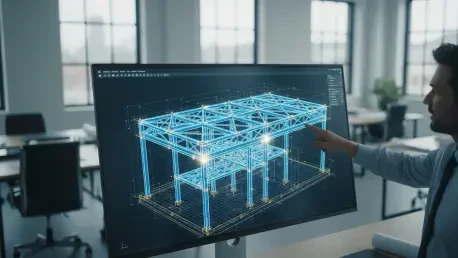

The painstaking process of manually counting steel members on static drawings has long served as the primary bottleneck in structural preconstruction, delaying project timelines and increasing the risk of costly human error. Solutions like ALLPLAN Steel Genie have disrupted this traditional workflow by utilizing advanced computer vision to interpret complex blueprints. This shift ensures that the estimating department no longer acts as a manual data entry hub but rather as a strategic center for project feasibility.
The Evolution: From Manual Takeoffs to Intelligent 3D Modeling
The transition from labor-intensive 2D manual counting to AI-driven 3D model generation represents a fundamental change in the structural steel landscape. While previous methods relied on highlighters and scale rulers, modern tools leverage machine learning to recognize patterns and spatial relationships. This progress is deeply intertwined with the maturation of Building Information Modeling, where data integrity across the project lifecycle is prioritized over fragmented documentation.
AI integration allows for a seamless bridge between flat sketches and voluminous digital data. By replacing static spreadsheets with dynamic models, the technology creates a foundation for better communication between architects and fabricators. This evolution has effectively removed the silos that previously hindered rapid project adjustments.
Core Technical Capabilities: The System Architecture
AI-Driven Object Detection: Accuracy in Extraction
At the heart of this technology lies an autonomous analysis system capable of parsing structural drawing sets to identify beams, columns, joists, and braces. Unlike basic character recognition tools, these AI models evaluate geometric context to extract precise parameters such as length, weight, and shear stud requirements. This level of granularity allows for a high-fidelity representation of the physical structure before a single piece of steel is ordered.
The software distinguishes itself by its ability to “read” drawings like a human engineer but at a far greater speed. It interprets the intent behind lines and symbols, translating them into quantifiable material lists. This capability reduces the burden of repetitive tasks, allowing professionals to focus on identifying potential design conflicts early.
Integrated AISC Connection Engine: Engineering Compliance
The inclusion of an integrated connection engine represents a significant departure from standard estimating tools that often ignore structural complexities. By applying AISC Design Guides directly to the extracted data, the software ensures that connections meet engineering standards automatically. This logic-driven approach transforms raw drawing data into a construction-ready model that accounts for moment connections and camber.
This implementation is unique because it combines estimation with real-world engineering constraints. By calculating connection weights and requirements during the initial takeoff, the system provides a more realistic cost profile. This prevents the frequent budget overruns associated with “missed” connection material in manual bids.
Latest Developments: Automating the Preconstruction Workflow
The industry is currently moving toward nearly instantaneous estimating, reducing the preconstruction timeline from several days to mere minutes. This acceleration is supported by the trend of moving away from fragmented spreadsheets and toward unified digital ecosystems. Such integration minimizes data loss and ensures that information captured during the bid phase remains actionable throughout the fabrication process.
Moreover, the shift toward automation has democratized high-level analysis for smaller fabrication shops. The ability to generate complex reports with minimal manual intervention allows these firms to compete on larger, more intricate projects. This trend highlights a broader industry movement toward transparency and data-driven decision-making.
Real-World Applications: Enhancing Fabrication Efficiency
Fabrication shops have successfully deployed this technology to drastically increase their bidding volume without expanding their headcount. By utilizing AI models as a foundation, detailing teams receive a significant head start, allowing for faster production planning and more accurate scope assessment. This competitive advantage is particularly visible in fast-track projects where rapid response times determine contract awards.
Firms using these tools have reported a notable reduction in the gap between estimated and actual costs. The ability to visualize the project in 3D during the bid stage allows for better resource allocation and logistics planning. This practical application demonstrates that AI is not just a theoretical improvement but a functional necessity for modern workshops.
Navigating Technical Challenges: The Human-Machine Balance
Despite these advancements, interpreting non-standardized 2D drawings remains a challenge that requires human oversight to ensure total accuracy. The digital divide between high-tech firms and traditional shops remains a market obstacle, often slowed by a reliance on legacy manual workflows. Ongoing development aims to improve AI detection in increasingly complex architectural designs to further reduce the need for manual correction.
The necessity for human verification ensures that the estimator’s professional judgment remains central to the process. While the software handles the bulk of the data processing, the professional identifies nuances or unique site conditions the AI might miss. This synergy between machine speed and human intuition is the current gold standard for the industry.
Future Outlook: The Role of Generative Engineering
Looking ahead, the integration of generative design and predictive analytics will likely redefine the estimator’s role even further. Future breakthroughs in interoperability between fabrication and detailing platforms will eliminate remaining data silos. This evolution will shift the workforce from clerical tasks toward high-level project strategy and risk management.
As predictive models become more sophisticated, they will likely offer insights into material price fluctuations and supply chain volatility. This will allow firms to hedge risks more effectively during the preconstruction phase. The long-term impact will be a more resilient and agile structural engineering sector.
Assessment: A Modern Verdict on AI-Estimating Solutions
The implementation of AI-estimating tools successfully modernized a sector that had remained stagnant for decades. These solutions provided the efficiency gains necessary to handle the growing complexity of modern architectural demands. By prioritizing data continuity and engineering logic, the technology established a new standard for the digital transformation of the construction industry.
Firms that adopted these tools saw immediate returns in accuracy and throughput. The transition from manual to automated workflows was a critical step in maintaining competitiveness in an increasingly digital market. Ultimately, the software proved to be an essential bridge between traditional engineering expertise and the future of automated construction.