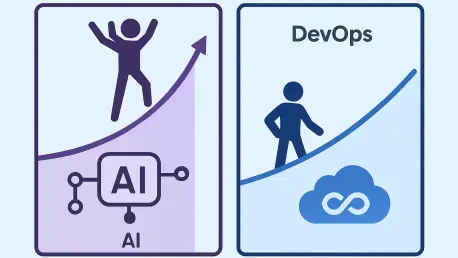

In an era where artificial intelligence (AI) is reshaping industries at an unprecedented pace, enterprises are racing to harness its potential to stay ahead of the curve, but the path to scaling AI initiatives is fraught with hidden obstacles that can derail even the most ambitious plans. Many organizations have leaned on Development Operations (DevOps), a proven framework for software deployment, to manage their AI projects. Yet, as AI systems grow in complexity, it’s becoming painfully clear that DevOps alone isn’t equipped to handle the unique demands of machine learning (ML) models. This is where Machine Learning Operations (MLOps) emerges as a game-changer, offering a specialized approach tailored to the dynamic, data-driven nature of AI. Unlike DevOps, which prioritizes system uptime and delivery speed, MLOps focuses on ensuring that AI decisions remain accurate and relevant over time. For businesses aiming to transform AI from a risky experiment into a reliable asset, understanding why MLOps takes precedence is not just helpful—it’s essential. This exploration delves into the critical differences between these two frameworks, unpacking the challenges of scaling AI, the strategic edge MLOps provides, and the powerful synergy when both approaches are combined. Through real-world examples and market insights, the argument will unfold to reveal why MLOps isn’t merely an option but a necessity for sustainable AI growth. Let’s embark on this journey to see how enterprises can navigate the complexities of AI scaling with confidence.
Bridging the Gap Between DevOps and MLOps
DevOps has been a cornerstone of modern software development for years, revolutionizing how teams build and deploy applications through continuous integration and delivery (CI/CD) pipelines. It’s a framework that thrives on automating infrastructure and ensuring applications run smoothly in production environments. The strength of DevOps lies in its ability to handle static code, where the product, once deployed, largely remains consistent until the next update. However, when applied to AI systems, this strength turns into a blind spot. AI isn’t static; it’s a living entity that evolves with data, and DevOps isn’t designed to manage such fluidity. This mismatch often leaves organizations struggling to keep their AI systems performing as expected, exposing a critical gap in operational capability.
MLOps, by contrast, steps into this void with a purpose-built framework for the world of machine learning. It goes beyond code to manage data, models, and algorithms, ensuring that every component of an AI system is tracked and optimized. Where DevOps focuses on whether a system is running, MLOps asks whether the decisions that system makes are correct. Think of it as a caretaker for AI’s intelligence, handling tasks like data versioning and model performance monitoring—elements that DevOps overlooks. This specialized focus makes MLOps indispensable for enterprises that want their AI initiatives to deliver sustained value. As businesses increasingly rely on AI for critical functions, the distinction between these two approaches becomes not just technical but strategic, shaping how effectively technology aligns with business goals.
Unpacking the Challenges of AI Scaling Without MLOps
Scaling AI initiatives using only DevOps is akin to navigating a stormy sea with a map designed for clear skies. AI systems are inherently dynamic, constantly interacting with new data that can shift in unpredictable ways, a challenge known as data drift. When models trained on historical data encounter these shifts, their accuracy often degrades, leading to flawed predictions that DevOps cannot detect or address. The result is often silent failures—situations where the system appears functional but delivers results that are wrong in a business context. For instance, a customer segmentation model might keep running smoothly under DevOps oversight, yet its outdated logic could misclassify high-value clients, costing a company significant revenue before the issue is even noticed.
Beyond silent failures, the operational strain of managing AI without a tailored framework is a heavy burden. Teams find themselves bogged down in manual troubleshooting, trying to pinpoint why a model isn’t performing as expected, instead of focusing on innovation. This reactive cycle drives up costs and slows progress, turning AI projects into resource sinks rather than value generators. DevOps, with its emphasis on deployment pipelines and system stability, lacks the tools to preemptively handle such AI-specific issues. Consequently, enterprises risk not only financial losses but also erosion of trust in AI as a reliable tool. The frustration of leadership can mount when promised outcomes fail to materialize, highlighting the urgent need for a more fitting approach to keep AI initiatives on track.
How MLOps Tackles AI’s Unique Demands
MLOps rises to the occasion by directly confronting the dynamic challenges of AI systems that DevOps struggles to manage. At its core, it offers continuous monitoring to catch issues like data drift or model degradation before they spiral into business problems. Imagine a predictive maintenance model in a manufacturing setting; without MLOps, a gradual decline in accuracy might go unnoticed until equipment failures rack up costs. MLOps intervenes by flagging these dips in performance in real-time, triggering alerts or automated retraining to keep the model aligned with current conditions. This proactive stance prevents the silent failures that plague AI systems, ensuring decisions remain trustworthy and relevant, which is a stark improvement over the reactive nature of traditional methods.
Moreover, MLOps brings much-needed automation to the table, slashing the manual effort involved in maintaining AI systems. Tasks like updating datasets, validating model outputs, and redeploying improved versions become streamlined processes rather than time-consuming chores. This shift frees up data scientists and engineers to focus on refining algorithms or exploring new use cases, rather than getting stuck in operational quicksand. Additionally, MLOps embeds governance into the workflow, ensuring that data lineage and model decisions are transparent and compliant with regulatory standards. For industries like finance or healthcare, where accountability is non-negotiable, this built-in oversight reduces risks of penalties or reputational damage. By addressing these critical pain points, MLOps transforms AI from a high-maintenance experiment into a scalable, controlled process.
Strategic Advantages of MLOps for Enterprise Growth
For business leaders, adopting MLOps isn’t merely a technical upgrade—it’s a strategic pivot that redefines how AI contributes to organizational success. By implementing MLOps, enterprises can move beyond treating AI as a series of one-off projects and instead integrate it as a core capability driving predictable results. This transition builds confidence among stakeholders, as AI outcomes become measurable and aligned with business objectives like revenue growth or risk reduction. Unlike DevOps, which ensures operational continuity, MLOps guarantees that the intelligence behind those operations delivers real value, making it a linchpin for long-term digital transformation.
The tangible benefits of this approach are hard to ignore. Enterprises leveraging MLOps often see deployment cycles accelerate by 60-80%, meaning AI solutions reach the market faster and start generating returns sooner. Manual maintenance tasks, which can consume significant resources, drop by 40-70%, allowing teams to redirect their efforts toward strategic priorities. Perhaps most telling is the impact on project success rates; without MLOps, a staggering 80% of AI models fail to make it to production effectively. MLOps reverses this trend, safeguarding investments by ensuring models perform reliably in real-world scenarios. These metrics underscore a clear reality: for leaders looking to maximize ROI and maintain a competitive edge, MLOps isn’t just beneficial—it’s a business imperative that turns AI into a sustainable driver of growth.
Synergy Between DevOps and MLOps in AI Scaling
Rather than viewing MLOps as a replacement for DevOps, savvy enterprises recognize the power of combining both frameworks to create a seamless operational engine for AI. DevOps lays the groundwork by managing infrastructure and ensuring applications are deployed reliably across environments. It’s the backbone that keeps systems running, handling everything from server uptime to application updates. However, while DevOps excels at delivery, it doesn’t address the intelligence within those systems. This is where MLOps complements it, focusing on the performance and accuracy of AI models to ensure that deployed solutions don’t just run but deliver meaningful outcomes.
This partnership shines in diverse AI applications, spanning industries and use cases. Consider a bank deploying a fraud detection system: DevOps ensures the platform is live and accessible without downtime, a critical foundation. Meanwhile, MLOps monitors the model’s effectiveness, detecting when new fraud patterns emerge and adjusting the system to maintain accuracy. Together, they cover both reliability and relevance, a dual focus that’s vital for scaling AI across functions like customer personalization or predictive analytics. By integrating these frameworks, enterprises avoid the pitfalls of choosing one over the other, instead building a robust ecosystem where technology and intelligence reinforce each other. This synergy isn’t just practical—it’s a strategic necessity for any organization serious about scaling AI with minimal friction.
Evidence from Industry Leaders Using MLOps
The impact of MLOps isn’t theoretical; it’s playing out in the strategies of some of the world’s most innovative companies. Take Netflix, which relies on its Runway platform to fine-tune content recommendations for millions of users globally. By embedding MLOps practices, Netflix ensures its models adapt to evolving viewer preferences, keeping engagement high and directly boosting subscription revenue. This ability to maintain model relevance in a fast-changing environment demonstrates how MLOps turns AI into a competitive weapon, delivering personalized experiences at scale that would be impossible with traditional DevOps alone.
Similarly, Microsoft’s Azure MLOps Framework is empowering enterprises across sectors like healthcare and finance to scale AI with confidence. This framework integrates continuous monitoring and governance, slashing the risks of model failures and ensuring compliance with stringent regulations. The result is operational efficiency that translates into cost savings and faster innovation cycles. Starbucks offers another compelling example through its Deep Brew platform, which uses MLOps to tailor customer offers and optimize store operations. This approach has fueled significant revenue growth by linking AI performance to tangible business outcomes. These examples illustrate a broader trend: industry leaders aren’t just adopting MLOps for technical reasons but as a strategic lever to drive market dominance, proving its value in real-world applications.
Market Momentum Behind MLOps Adoption
The growing importance of MLOps is reflected in striking market data that signals a profound shift in enterprise priorities. Valued at $2.19 billion in 2024, the global MLOps market is projected to skyrocket to $16.61 billion by 2030, a clear indicator of its transition from a niche concept to a foundational element of AI strategy. This explosive growth isn’t driven by hype but by a collective realization among businesses that scaling AI without structured operations is a recipe for failure. Companies are investing heavily to move beyond experimentation and embed AI into their core processes with reliability and accountability.
This trend also reshapes the competitive landscape in meaningful ways. Enterprises that adopt MLOps early gain a distinct advantage, deploying AI solutions faster and with fewer missteps compared to those still grappling with ad-hoc approaches. The emphasis is shifting from merely innovating with AI to mastering how it’s run, a focus on operational discipline that separates leaders from laggards. As investment pours into MLOps tools and platforms, the barrier to entry for smaller firms is lowering, enabling broader adoption across industries. What’s evident from this momentum is that MLOps isn’t a passing fad but a critical component of modern business strategy, positioning it as the linchpin for any organization aiming to harness AI at scale.
Leadership’s Pivotal Role in MLOps Implementation
The success of MLOps in any enterprise often hinges on the commitment and vision of its leadership, rather than just technical expertise. When executives treat MLOps as a peripheral tool rather than a strategic operating model, initiatives falter, lacking the resources and focus needed to scale effectively. Without top-down support, AI projects can fragment across departments, leading to inconsistent results and wasted effort. Leaders must champion MLOps by aligning it with broader business goals, ensuring it’s not siloed as a tech concern but integrated into discussions of revenue, risk, and customer impact. This strategic oversight is what transforms AI from a gamble into a dependable asset.
A common misstep among leadership is underestimating the governance demands of AI, often deferring accountability until issues arise. Relying solely on DevOps practices or scaling AI prematurely without stable MLOps pipelines can lead to unstable systems that erode trust. By contrast, leaders who prioritize MLOps from the outset embed accountability into workflows, ensuring clear ownership of model performance and regulatory compliance. This proactive stance not only mitigates risks but also fosters confidence among stakeholders, proving that AI can deliver on its promises. Ultimately, leadership’s role isn’t just to approve budgets but to drive a cultural shift where operational rigor in AI is as valued as innovation, paving the way for sustainable success.
The High Stakes of Neglecting MLOps
Overlooking MLOps in favor of relying solely on DevOps can lead to operational pitfalls that jeopardize an enterprise’s bottom line and reputation. One of the most insidious risks is silent model failure, where AI systems continue to operate without flagging that their outputs are no longer accurate. Unlike software glitches that DevOps might catch through error logs, these failures in AI often hide beneath the surface, delivering predictions that seem plausible but are wrong in context. For a logistics firm, this could mean a demand forecasting model misallocating resources, leading to overstocked warehouses or missed deliveries, with financial ripple effects that compound over time before detection.
The longer such issues persist, the steeper the toll on both finances and credibility. Consider a healthcare provider using AI for patient diagnostics; without MLOps to monitor model drift, outdated algorithms might misdiagnose conditions as data patterns shift, risking patient outcomes and legal exposure. MLOps acts as a critical safeguard, employing real-time monitoring to spot discrepancies early and prevent escalation. Beyond immediate losses, neglecting MLOps undermines trust in AI as a tool for decision-making, potentially stalling future investments. The high stakes here aren’t just about avoiding failure but about preserving AI’s role as a strategic ally, a role that only MLOps can secure with its focused operational lens.
Envisioning the Future of MLOps and DevOps Together
As enterprises look ahead, the trajectory of MLOps suggests it will become as integral to business operations as DevOps has been for software delivery. The future isn’t about one framework eclipsing the other but about a deeper collaboration that supports increasingly sophisticated intelligent systems. MLOps will evolve to take on a central role in enterprise infrastructure, standardizing practices for managing AI much like CI/CD did for code. This shift will enable companies to handle complex use cases—think autonomous supply chains or real-time financial modeling—with greater reliability, embedding AI deeper into strategic functions.
Automation within MLOps is set to advance beyond mere deployment speed, focusing instead on optimizing decision quality. Envision systems that automatically recalibrate models when business KPIs falter, not just when technical errors surface, ensuring outcomes stay aligned with goals. Governance will also transform, moving from reactive policies to proactive integration within pipelines, flagging ethical or compliance risks before they materialize. This evolution, paired with DevOps’ steadfast focus on infrastructure, promises a landscape where AI failures stem less from technology and more from execution. Enterprises mastering this balance through MLOps and DevOps collaboration will outpace competitors, redefining advantage not by who builds AI first, but by who runs it best.