
The modern engineering floor often vibrates with the quiet intensity of developers interacting with large language models, yet the mere presence of these tools does not equate to organizational excellence. By 2026, the novelty of the generative interface has faded, replaced by a pressing need for a structured maturity model that distinguishes between superficial usage and deep operational integration. Organizations that once celebrated high seat-license adoption are now realizing that a developer with a chatbot is not a strategy; it is a temporary productivity boost that often stays trapped within the confines of an individual’s browser tab. True maturity is measured by how much responsibility the system can reliably shoulder when the human is no longer actively prompting it.
As the industry moves through 2026 and toward 2028, the gap between “using AI” and being “AI-native” has become the primary indicator of competitive advantage. Software engineering leaders are increasingly moving away from the vanity of interaction metrics and toward a focus on system-wide autonomy. The shift is subtle but profound: it represents the transition from AI as a sidecar that assists a human to AI as a component of the engineering stack that drives outcomes. This evolution is necessary because the volume of code, the complexity of modern cloud architectures, and the speed of delivery requirements have surpassed the cognitive limits of manual human oversight.
Moving Beyond the Chatbot: Why Usage Is Not Maturity
The distinction between a team that happens to use large language models and one that has achieved true maturity is often obscured by the sheer volume of generated code. Engineering leaders frequently point to high engagement with coding assistants as a triumph, yet these metrics frequently mask a fundamental lack of operational depth. If the value generated by the AI disappears the moment a developer closes their session window, the organization has not achieved maturity; it has simply optimized for faster typing. Real progress is found in the persistence of the value—how the underlying workflow remains changed even after the immediate task is finished.
Furthermore, maturity is defined by the degree to which an AI system is permitted to interact with the broader production environment. In many organizations, AI remains sandboxed, isolated from the very systems it is meant to improve. This isolation creates a “context ceiling” where the AI can suggest snippets but cannot understand the architectural implications of those suggestions. When a system is mature, it no longer asks for the context; it possesses it through deep integration with the code repositories, the ticketing systems, and the telemetry pipelines that define the software lifecycle.
The move toward maturity also requires a cultural shift in how failure is perceived. In the early days of adoption, an incorrect AI suggestion was seen as a sign of the tool’s unreliability, leading to hesitation. In 2026, a mature organization treats LLM uncertainty like network latency or database scaling—as an engineering constraint to be managed rather than a reason for abandonment. This mindset allows teams to build robust guardrails that enable the AI to operate at higher levels of responsibility, moving from a simple assistant to a trusted, albeit supervised, digital colleague.
The Shift From Individual Tasks to Integrated Workflows
Transitioning from experimental lunch-and-learn sessions to robust infrastructure requires a fundamental shift in perspective from the task to the workflow. For too long, the industry focused on “Individual Assistance,” where the unit of value was a single function or a specific debugging answer. To move forward, leadership must stop viewing generative intelligence as a search engine for code and start treating it as a dynamic part of the continuous integration and delivery pipeline. This evolution matters because the goal is no longer just “faster typing,” but a complete redesign of how software is delivered and maintained in a high-stakes environment.
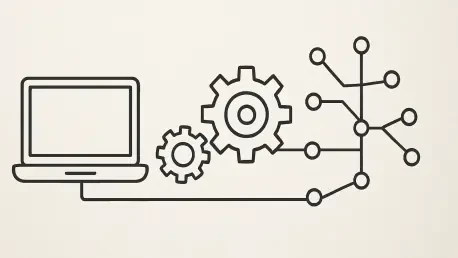
As teams integrate these tools more deeply, the “copy-paste” model of development begins to dissolve. In a mature workflow, the AI does not just provide a draft that a human must manually move from one tool to another; it interacts directly with the version control system or the deployment orchestrator. This “wiring” of the tech stack allows for a seamless flow of data where the AI can pull its own context from logs or databases. When the system can identify a performance bottleneck in a production environment and automatically draft the corresponding fix in a pull request, the focus of the engineer shifts from implementation to orchestration.
Moreover, the redesign of these workflows allows for a new level of “always-on” engineering. Traditional development is constrained by human availability, but integrated AI workflows can operate throughout the 2026-2027 development cycle with constant vigilance. This shift allows for the automation of high-volume, low-ambiguity tasks that previously drained engineering resources, such as dependency updates, documentation maintenance, and initial log triage. By offloading these burdens to an integrated system, the engineering team can refocus on high-level strategy and creative architecture, which remain the domain of human intuition.
The Five Stages of the AI Maturity Model
At the baseline of the maturity model, known as Stage 1: Individual Assistance and Isolated Tasks, the technology functions as a sophisticated “sidecar” for the individual developer. Use cases are restricted to ephemeral activities like explaining a legacy code snippet, generating boilerplate, or basic debugging. The defining characteristic of this stage is a total lack of system context; once the conversation window is closed, the organizational value is lost because the system has no connection to the broader codebase or project history. It is a world of high-speed local optimization that rarely impacts the global efficiency of the engineering department.
Maturity grows as teams reach Stage 2: Workflow Assistance and Contextual Integration, where AI is woven into repeatable development activities such as drafting pull request descriptions or generating test cases. At this stage, the system begins to consume context from the environment, reading the diffs of a code change or the requirements in a ticket. However, the operational model remains “human-in-the-loop by default.” The AI provides a draft, but a human must manually validate and “copy-paste” the output into the relevant tool before any action occurs, maintaining a heavy cognitive load on the engineer.
The transition to Stage 3: Integrated Automation via System Wiring represents an architectural leap where the technology is “wired into” the tech stack through APIs, webhooks, and CI/CD pipelines. Manual data entry is largely eliminated as the system gains the ability to pull its own data from logs, databases, or ticket histories without human prompts. This stage shifts the focus from writing clever prompts to traditional engineering disciplines, including rigorous data boundaries and error handling. It is here that the system stops being an external tool and starts being a core part of the internal infrastructure.
At Stage 4: Agentic Operations and Delegated Decision-Making, the focus shifts from “output” to “outcome.” AI agents can reason through multi-step problems, select appropriate tools, and prepare sequences of actions. For example, rather than just diagnosing a server error, an agent might prepare a rollback command, verify the health of the previous build, and present the entire plan for a single-click approval. The AI is no longer just a drafter; it is an orchestrator operating within engineered boundaries, capable of navigating complex, non-linear workflows with minimal guidance.
The final stage, Stage 5: Governed AI-Native Delivery, is defined by total observability and professionalized control. In a Stage 5 organization, every autonomous action is auditable, reversible, and governed by strict cost and security protocols. Failure is no longer an unpredictable surprise but a designed-for engineering constraint. The team can answer “why” and “how” for every autonomous action, ensuring that the system is self-healing and self-documenting. At this level, the delivery process itself is transformed into a governed, autonomous loop that maintains the health of the production environment with surgical precision.
Governance and the TRACE Framework for Engineered Trust
To safely progress through the higher stages of maturity, teams must adopt a framework that manages the inherent uncertainty of large language models. Experts suggest the TRACE framework as a roadmap for maintaining control as autonomy increases across the organization. The first pillar, Tiered Autonomy, requires explicitly defining which actions the AI can take independently and which require human intervention. This ensures that high-risk changes, such as modifying core security protocols, remain under strict human supervision while low-risk tasks like documentation formatting are fully automated.
The second and third pillars, Reversibility and Access Control, form the backbone of operational safety. Reversibility ensures that every change made by an AI agent—whether it is a code commit or a configuration update—can be instantly undone without disrupting the entire system. Access Control treats AI agents as distinct entities with scoped permissions, ensuring they only access the data necessary for their specific task. This prevents “privilege escalation” where an agent might inadvertently access sensitive customer data or critical infrastructure settings while performing a routine maintenance task.
The final components of the framework are Continuous Assurance and Explainability. Continuous Assurance involves implementing ongoing monitoring to track AI performance, accuracy, and “drift” over the 2026-2029 period as models and codebases evolve. This is paired with Explainability, which maintains the ability to audit the reasoning and data sources behind every AI-driven decision. By ensuring that every autonomous action is transparent, engineering teams can build the trust necessary to delegate higher levels of responsibility, moving the organization from a state of cautious experimentation to one of confident, governed execution.
Practical Strategies for Measuring and Scaling Maturity
Engineering leaders must move away from “AI theater” by tracking metrics that reflect actual workflow depth rather than just tool usage. One of the most critical metrics is the Human Intervention Rate, which tracks how often a human must correct or override an AI suggestion. A decreasing rate over time indicates rising system reliability and better contextual integration. Similarly, Workflow Depth measures the percentage of core engineering workflows where AI is a required, integrated component rather than an optional, external tool. These KPIs provide a realistic view of how deeply the technology has actually penetrated the production lifecycle.
Another essential metric for 2026 is Economic Efficiency, which compares the cost per completed AI-driven task against the traditional manual labor cost. This goes beyond simple time-saving and looks at the total cost of ownership, including the compute costs of the models and the engineering hours required to maintain the “wiring” and guardrails. Additionally, Governance Ratios help measure the percentage of AI actions that operate within “confidence thresholds” without requiring manual oversight. High governance ratios suggest that the organization has successfully engineered trust into its systems, allowing for true scale.
Identifying the right candidates for full automation is a strategic necessity, as not every task belongs in Stage 5. Creative architecture and high-level strategy often benefit from staying in the “Individual Assistance” phase to preserve human intuition and the “spark” of innovation. Conversely, workflows that are repetitive, involve structured data, and have high-stakes but reversible outcomes—such as log triage, unit testing, and documentation—are the primary candidates for agentic operations. Leaders who prioritized the “wiring” of these high-volume, low-ambiguity tasks first saw the greatest return on investment and the lowest rates of deployment friction.
The journey through the stages of maturity proved to be a fundamental reimagining of the engineering discipline. Teams that reached the final stages successfully transformed their legacy pipelines into self-healing systems that operated with a level of precision previously thought impossible. These organizations redirected their human talent toward complex problem-solving and strategic growth, while the AI-native infrastructure handled the repetitive complexities of modern software delivery. This shift did not just improve efficiency; it redefined the very nature of what it meant to be a software engineer in a world where the system itself became an active participant in its own evolution. Future strategies focused on further refining these autonomous loops to ensure that every engineering action remained observable and secure.