
Australia’s transition toward a renewable-heavy energy mix has historically been hampered by the fragmented nature of distributed assets that struggle to communicate across inconsistent platforms. As the nation pushes for higher decarbonization targets, the technical debt of legacy monitoring systems becomes a significant bottleneck for utility-scale operators. Global Power Generation Australia (GPGA) recently addressed this challenge by commissioning a massive cloud-based, AI-ready Supervisory Control and Data Acquisition (SCADA) system. This initiative, developed alongside Siemens and its automation partner Mescada, represents a pivotal shift toward digital synchronization. By consolidating diverse assets such as wind farms, hybrid solar installations, and Battery Energy Storage Systems (BESS) into a single management interface, the project provides the high-fidelity visibility required to manage modern power fluctuations. This transition effectively moves the industry away from isolated site management toward a truly holistic energy ecosystem.
The Technological Shift Toward Unified Infrastructure
Centralized Architecture and Scalability: The New Backbone
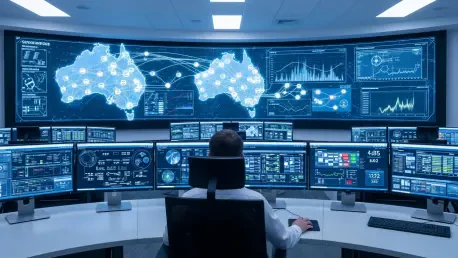
Implementing the Simatic WinCC Open Architecture provides a platform-independent foundation that is capable of managing approximately 300,000 data tags across eight separate geographical sites. These locations, spanning New South Wales, Victoria, Western Australia, and the Australian Capital Territory, formerly operated on disparate legacy systems that limited real-time data exchange and comparative analysis. By unifying these assets, the centralized control room in Canberra now serves as a single source of truth for the company’s entire 1GW operational capacity. This structural consolidation is not merely about convenience; it is a prerequisite for GPGA’s ambitious expansion roadmap. As the organization scales its portfolio from 1.4GW toward a 3GW target, the inherent flexibility of a cloud-ready SCADA ensures that new assets can be onboarded with minimal friction. This modular approach allows for rapid deployment without the need to overhaul existing physical infrastructure at every new site.
Strategic Integration and Market Resilience: Navigating the Grid
Beyond internal monitoring, the second phase of this deployment emphasizes direct connectivity with the Australian Energy Market Operator (AEMO). This specific integration is vital for maintaining national energy security because it allows the centralized platform to respond dynamically to grid demands and volatile market fluctuations. In a landscape where energy prices and frequency stability requirements shift by the minute, having a direct pipeline to market authorities ensures that renewable assets can be dispatched efficiently. This level of synchronization reduces the risk of curtailment and improves the overall reliability of the renewable supply chain during peak demand periods. Moreover, the transition to a unified communication protocol simplifies regulatory compliance, as reporting and data logging are now standardized across all state borders. By bridging the gap between local generation and national grid requirements, the system transforms static assets into active participants in the broader energy market.
Advanced Capabilities and Future-Proofing Energy Networks
Artificial Intelligence and Operator Efficiency: Smart Energy Management
The incorporation of generative AI and smart node technology marks a significant departure from traditional industrial automation frameworks that rely solely on reactive alarms. These “smart” features provide operator assistance by synthesizing vast amounts of telemetry data into actionable insights, allowing technicians to identify potential equipment failures before they occur. By utilizing sophisticated API integrations, the system bridges the gap between operational technology and information technology, creating a seamless flow of data for predictive maintenance. This shift toward “smart” energy management is essential for handling the complexities of hybrid sites where solar, wind, and battery storage must work in perfect unison. As operators interact with the AI-enhanced interface, the learning models refine their understanding of site-specific anomalies, further reducing downtime. This proactive management style ensures that the infrastructure remains robust enough to handle the evolving demands of the energy transition.
Industry Standards and Sustainability: A Model for Digitalization
Stakeholders across the renewable sector viewed this project as a definitive case study in how digitalization supports operational excellence across widely distributed assets. The collaboration between Siemens and GPGA demonstrated that stabilizing the grid requires more than just hardware; it demands sophisticated software layers that can interpret complex data in real-time. By prioritizing a future-proof architecture, the project established a blueprint for other utility-scale developers seeking to navigate the intricacies of a decarbonized future. This initiative was a core component of the broader sustainability journey, proving that digital tools are indispensable for managing the high-variable nature of wind and solar power. Looking forward, the emphasis on open architecture ensures that the system will remain compatible with emerging technologies throughout the 2026 to 2030 period. The project concluded by reinforcing the idea that a centralized, data-driven approach is the most effective way to meet the rigorous regulatory and market requirements.
The successful implementation of this unified SCADA framework demonstrated that the move toward 100% renewable penetration required a fundamental shift in how data was valued within the utility sector. Decision-makers recognized that investing in platform-independent software was the only way to avoid vendor lock-in while maintaining the agility needed for rapid market shifts. The project provided a clear path for integrating generative AI into the control room, which significantly lowered the cognitive load on operators during grid instability events. Future considerations focused on expanding these digital twins to include even more granular weather prediction models and market-bidding algorithms. By treating energy assets as interconnected nodes rather than isolated power plants, the industry moved toward a more resilient and automated national grid. These advancements suggested that the next logical step involved the widespread adoption of autonomous grid balancing, where AI agents managed multi-gigawatt portfolios with minimal human intervention.