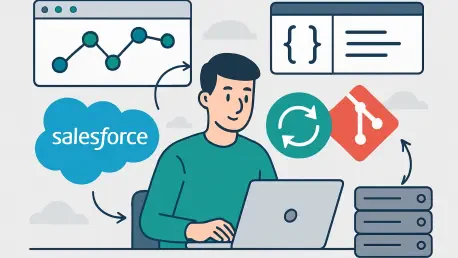

The rapid evolution of the Salesforce platform has created a significant challenge for development teams, forcing them to reconcile the worlds of declarative, low-code development with the rigorous demands of modern software engineering. As organizations scale their use of the platform, the traditional methods of managing changes through manual processes and change sets have become untenable, leading to deployment errors, overwritten work, and a lack of reliable version history. The industry is now undergoing a critical transformation, recognizing that Salesforce development is not a separate discipline but a high-stakes software engineering practice that requires the same level of process maturity, automation, and security as any other enterprise system. At the DevOps Dreamin’ London 2025 conference, OrgFlow demonstrated a solution engineered to address this very challenge, showcasing a platform that fundamentally redefines the development lifecycle by making Git, the cornerstone of modern version control, a non-negotiable core component rather than an optional integration.
A Deep Dive into OrgFlow’s Core Capabilities
Establishing a Single Source of Truth with Stateful Synchronization
A primary obstacle in maturing Salesforce DevOps is the persistent drift that occurs between the live state of a development environment and its representation in a version control system. Without a disciplined process, the Git repository often becomes an outdated archive rather than a reliable source of truth, making it difficult to track changes, debug issues, or confidently promote features through a release pipeline. OrgFlow addresses this foundational problem through its stateful synchronization engine, which begins by directly mapping specific Salesforce orgs to corresponding branches within a Git repository. This one-to-one mapping creates an unambiguous and continuously auditable link, transforming the abstract concept of version control into a tangible, enforced reality. This structure ensures that every sandbox, UAT environment, and even the production org has a dedicated Git branch that serves as its definitive historical record, eliminating the guesswork and manual reconciliation that plague so many development teams.
This direct mapping enables a truly bidirectional and continuous flow of metadata, a process OrgFlow refers to as maintaining “Stack Alignment.” The platform’s stateful engine moves beyond the limitations of simple, one-way deployments by actively monitoring both the Salesforce org and its linked Git branch for changes. When a developer or administrator makes a declarative change directly in a sandbox, the system can automatically detect it, package it, and commit it to the corresponding branch with a clear message. Conversely, when a new commit is pushed to a branch from a developer’s local machine, the platform can automatically deploy that change into the linked Salesforce org. This persistent, automated synchronization ensures that the Git repository is never out of sync with the environment it represents. It becomes a living, breathing reflection of the org’s state, solidifying its role as the indisputable single source of truth for the entire release pipeline and providing a complete, granular history of every modification.
Eliminating ‘Merge Hell’ with Semantic Intelligence
One of the most notorious and time-consuming challenges in team-based Salesforce development is the management of merge conflicts, particularly within complex XML metadata types like Profiles and Permission Sets. Standard version control tools, including Git itself, operate on a line-by-line textual comparison. This approach fails when multiple developers make non-conflicting logical changes to the same large XML file. For instance, if one developer adds permission for a new field on line 500 of a Profile file and another adds access to a new Apex class on line 800, a standard merge tool will often flag this as a conflict simply because the changes occurred within the same file. This triggers a manual, error-prone resolution process often dubbed “merge hell,” where a developer must painstakingly review the XML to manually combine the changes, risking syntax errors or accidentally overwriting a colleague’s work. This technical limitation creates a significant bottleneck in the development lifecycle, discouraging frequent commits and slowing down the entire team’s velocity.
To solve this critical issue, OrgFlow has engineered a semantic merging engine that intelligently understands the logical structure and meaning of Salesforce XML metadata. Instead of performing a simple text-based comparison, the engine parses the XML file to comprehend the intent behind each change. It recognizes distinct components like field permissions, object permissions, Apex class access, and layout assignments as separate, manageable units. Returning to the previous example, the semantic engine would correctly identify that one developer added a specific field permission while the other added a distinct class access. Recognizing these as two separate and compatible additions to the Profile, the system automatically merges them into a single, valid XML file without requiring any manual intervention. This intelligent conflict avoidance dramatically reduces the friction of team-based development, enabling developers to work in parallel on the same metadata components with confidence and saving countless hours previously lost to tedious and risky manual merges.
Building a Complete and Secure DevOps Pipeline
Integrating Quality Gates with Automated Apex Testing
In modern DevOps, the principle of “shifting left” is crucial for building high-quality software, emphasizing the need to find and fix defects as early as possible in the development lifecycle. Applying this to Salesforce requires integrating quality assurance directly into the workflow rather than treating it as a final, pre-deployment step. OrgFlow embeds this philosophy into its platform by functioning as a critical quality gate within the release pipeline. The system allows teams to configure automated Apex test executions that are triggered by key events, such as a synchronization or a validation command. This means that every time a developer attempts to commit their changes from a sandbox into the version control system, a predefined suite of tests can be run automatically. This practice moves quality checks from a delayed, manual process to an immediate, automated checkpoint, providing developers with instant feedback on the stability and integrity of their code before it ever gets merged into the main development branch.
This integrated testing capability is more than just a reporting tool; it acts as a powerful enforcement mechanism for quality standards. Within the platform, users can define strict success criteria, including code coverage thresholds and the requirement that all tests must pass. If a test fails in the source environment, OrgFlow can be configured to block the synchronization entirely, preventing the broken or unstable code from progressing to any upstream environment, such as a User Acceptance Testing (UAT) org or, critically, production. The system provides clear, visual reports on test execution success, failures, and coverage metrics, making it easy to diagnose issues quickly. By actively preventing flawed code from moving through the pipeline, this proactive quality gate ensures that only validated, high-quality code is promoted, significantly reducing the risk of introducing regressions and enhancing the overall stability of the production environment.
Empowering Both ‘Clicks’ and ‘Code’ Developers
Recognizing that a successful Salesforce team is composed of professionals with diverse technical skill sets, the OrgFlow platform is explicitly designed to be both powerful and accessible to the full spectrum of users. For professional developers and DevOps engineers—the “pro-code” personas—the platform offers a robust and highly scriptable Command-Line Interface (CLI). This CLI is the engine for automation, allowing teams to build sophisticated, end-to-end DevOps processes. It integrates seamlessly with industry-standard CI/CD engines such as GitHub Actions, Azure DevOps, and Jenkins. Using the CLI, DevOps specialists can script every aspect of the release pipeline, from automated validation and testing on every commit to scheduled deployments and orchestrated data seeding. This level of control and flexibility empowers teams to construct a fully automated, lights-out delivery process that aligns Salesforce development with mature software engineering best practices.
Simultaneously, the platform caters to Salesforce administrators and declarative developers—the “clicks-not-code” personas—through an intuitive graphical user interface known as OrgFlow Desktop. This visual tool democratizes access to powerful DevOps capabilities, eliminating the need for command-line expertise. Through the Web UI, administrators can easily configure and manage deployment “Flows,” visually compare the metadata differences between various environments and their corresponding Git branches, and select specific changes to promote. With simple button clicks, they can initiate complex synchronization and validation operations that execute with the same power and reliability as the CLI. This dual-interface approach ensures that every team member, regardless of their technical background, can participate in and benefit from a structured, version-controlled release process, fostering greater collaboration and unifying the entire team under a single, consistent workflow.
Commitment to Community and Modern DevOps Principles
OrgFlow’s participation in DevOps Dreamin’ London 2025, an event that notably supported the breast cancer awareness charity CoppaFeel!, reflected a commitment that went beyond showcasing technology. It demonstrated an investment in the health and growth of the Salesforce community itself. The company’s presence at the event served to reinforce a singular mission: to provide a robust framework that empowers all Salesforce teams to build and release software with the confidence, discipline, and security that have long been standard in other areas of enterprise software engineering. By centering its entire methodology on Git as the immutable source of truth, OrgFlow offered attendees a clear path to resolving some of the most persistent challenges in the ecosystem, from eliminating manual merge conflicts to enforcing quality through automated gates. This showcase ultimately provided a blueprint for teams looking to transition from ad-hoc processes to a mature, predictable, and scalable DevOps model.