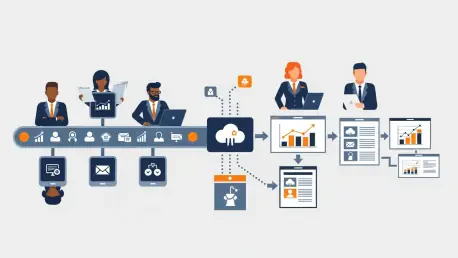

The rapid acceleration of global data generation has forced modern enterprises to move beyond static spreadsheets into dynamic, automated environments that prioritize immediate intelligence over historical archival. In the current 2026 landscape, the ability to synthesize petabytes of information into actionable strategy is no longer a luxury but a fundamental requirement for survival in a volatile global economy. As companies aggressively migrate their core operations to sophisticated cloud infrastructures, the focus has shifted toward refining the underlying methodologies used to ingest, process, and interpret this vast digital exhaust. Traditional manual data handling has effectively vanished, replaced by high-velocity frameworks that operate with minimal human intervention. This shift highlights a critical tension between three primary architectural patterns: the established Extract, Transform, Load (ETL) model; the agile Extract, Load, Transform (ELT) approach; and the pioneering Zero-ETL paradigm that promises to eliminate movement friction entirely. Selecting the most appropriate framework dictates how quickly a brand can pivot in response to emerging market signals.
Understanding Traditional Data Integration
The Mechanics and Challenges of the ETL Framework
For several decades, the Extract, Transform, Load framework served as the undisputed standard for managing enterprise information systems. This methodology was originally developed during a period when digital storage was prohibitively expensive and computing resources were highly centralized and restricted. To manage these constraints, data had to be meticulously refined, filtered, and minimized before it ever reached a permanent storage warehouse. This rigorous three-stage process begins with extraction, where information is harvested from diverse sources such as legacy relational databases or specialized enterprise applications. Once pulled into a staging environment, the transformation phase begins, involving complex logic to clean the data, correct structural errors, and join disparate points into a unified record. Finally, the sanitized and formatted data is loaded into the warehouse. Because the heavy lifting occurs before storage, the resulting datasets are incredibly lean and optimized for high-speed querying by business analysts.
Despite its historical success, the rigid nature of ETL presents significant hurdles in the modern high-speed business environment. The most pressing issue is latency, as the multi-step process creates an inherent delay between the moment data is generated and the moment it becomes available for analysis. In a market where decisions must be made in minutes rather than days, this lag can result in missed opportunities and outdated intelligence. Furthermore, ETL pipelines are notoriously brittle and resource-intensive, requiring constant manual updates whenever a source system changes its data format. The transformation stage demands substantial computational power, often necessitating expensive dedicated servers that can strain operational budgets. While the model acts as a reliable gatekeeper for data quality, the sheer maintenance burden often slows down the very innovation it was meant to support. Organizations frequently find themselves spending more time fixing broken pipelines than actually deriving value from the information they collect.
Strategic Implementation of Legacy Systems
Even with the rise of newer technologies, the strategic use of traditional ETL remains essential for specific industrial applications where precision is more important than speed. In sectors like healthcare or government administration, the “gatekeeper” function of ETL ensures that only the most accurate and compliant data enters the system, which is vital for maintaining public trust and safety. For instance, a hospital system in 2026 might use ETL to synchronize patient records across multiple clinics, ensuring that every piece of medical history is perfectly formatted and verified before being committed to a central ledger. By scrubbing the data in a secure staging area, administrators prevent the ingestion of corrupted or incomplete records that could lead to critical errors in patient care. This meticulous approach to data integrity is why ETL continues to be the gold standard for regulatory reporting and auditing processes where the cost of a single error far outweighs the benefits of real-time processing.
Beyond compliance, the storage efficiency offered by ETL provides a compelling economic argument for organizations dealing with massive volumes of structured archival data. By filtering out noise and irrelevant metadata during the transformation stage, companies can significantly reduce their long-term storage footprints in the cloud. This becomes particularly relevant for firms managing historical financial transactions or longitudinal research studies where only specific variables are needed for long-term trend analysis. Instead of paying to store billions of raw, messy data points, an organization can use ETL to compress and refine that information into a highly dense and searchable format. This optimization allows budget-conscious IT departments to maximize their cloud investments while still providing analysts with the specific, high-quality information required for deep-dive reporting. Consequently, ETL has evolved from a general-purpose tool into a specialized instrument for high-stakes, precision-driven data management.
Transitioning to Modern Cloud Architectures
Leveraging Speed and Scalability with ELT
The transition to modern cloud environments has revolutionized data handling by introducing the Extract, Load, Transform (ELT) model, which prioritizes agility over pre-storage refinement. This approach effectively flips the traditional methodology on its head by moving the transformation step to the very end of the pipeline, utilizing the massive parallel processing power of modern cloud warehouses. In an ELT workflow, raw data is extracted from its source and immediately pushed into a cloud-based data lake or warehouse in its native format. This allows for nearly instantaneous data ingestion, which is critical for organizations that need to capture and store high-frequency information from web sensors or social media feeds. Once the data resides within the cloud environment, the system leverages elastic compute resources to perform transformations on-demand. This means that analysts can decide how to clean or aggregate the data long after it has been collected, providing a level of flexibility that was previously impossible.
The primary advantage of ELT lies in its ability to scale effortlessly with the growing demands of the big data era. Because the transformation logic is decoupled from the loading process, businesses can ingest petabytes of information without worrying about the immediate computational cost of cleaning it. This creates a “data-first” culture where the priority is to capture every possible signal, leaving the specific analysis for a later stage. Furthermore, ELT enables a more iterative approach to business intelligence; if an analyst discovers a new way to interpret the raw data, they can simply run a new transformation script without needing to re-extract everything from the source. This adaptability is essential for competitive research and development, as it allows teams to experiment with different models and hypotheses in real-time. By removing the bottleneck of pre-load processing, ELT empowers modern enterprises to move at the speed of the internet.
Economic Impacts of Shifted Processing
While ELT offers undeniable speed, its implementation introduces a different set of economic and operational considerations compared to older models. The most notable shift is in the allocation of cloud budgets, as companies often trade lower maintenance costs for higher storage and compute expenses. Because raw, untransformed data is stored in its entirety, the total volume of information sitting in the cloud can grow exponentially, leading to significant monthly storage fees. However, many organizations find this trade-off acceptable because it reduces the need for large teams of specialized data engineers to maintain brittle ETL pipelines. Instead, they can utilize the built-in scalability of cloud platforms to handle the heavy lifting, essentially paying for performance on a consumption basis. This shift in spending from human labor to cloud infrastructure represents a fundamental change in how modern technology departments are managed and funded in the current year.
The move to ELT also impacts the talent pool and the specific skill sets required within a data-driven organization. With the transformation stage happening inside the data warehouse, there is an increased demand for analysts who are proficient in advanced SQL and internal cloud scripting languages. This democratizes the data transformation process, allowing business analysts to take a more direct role in shaping the information they use, rather than waiting for a centralized IT team to deliver a finished report. However, this decentralized approach requires a robust internal governance framework to ensure that raw data does not lead to “dirty” or misleading insights. Without strict controls over who can create and run transformation scripts, an organization risks creating a “data swamp” where inconsistent logic leads to conflicting business reports. Therefore, the successful adoption of ELT relies as much on cultural and procedural discipline as it does on the underlying cloud technology.
Navigating the Future of Data Automation
Strategic Implementation and Emerging Trends
Current industry trends indicate a clear movement toward hybridization, where the most successful enterprises no longer view ETL and ELT as mutually exclusive options. Instead, architects are designing sophisticated multi-path pipelines that route data through different frameworks based on the specific requirements of the business unit. For instance, a global retail corporation might utilize a high-speed ELT path to monitor real-time inventory levels and customer clicks during a major holiday sale, while simultaneously running a traditional ETL process for their end-of-year financial reconciliation. This hybrid strategy allows the firm to benefit from the rapid insights provided by the cloud while maintaining the ironclad data integrity required for legal and tax compliance. By treating data automation as a modular system, leadership teams can optimize for both performance and precision, ensuring that the technology stack remains as flexible as the market demands.
Another significant development in 2026 is the rapid maturation of the Zero-ETL concept, which seeks to eliminate the manual construction of pipelines entirely. Major cloud providers have begun offering native integrations that allow data to flow seamlessly between operational databases and analytical warehouses without any user-defined movement logic. This innovation represents a major step toward the “holy grail” of data management: real-time access with zero operational overhead. For a technology startup, this means they can launch a new application and immediately see user behavior reflected in their analytics dashboard without writing a single line of integration code. While this technology is still evolving, its presence is already reducing the barrier to entry for smaller firms that lack the budget for extensive data engineering teams. As these automated connections become more common, the focus of the industry will likely shift away from the mechanics of moving data toward the more valuable task of interpreting it.
Operationalizing Zero-ETL and Hybrid Models
To successfully transition into this new era of automation, organizational leaders must first perform a comprehensive audit of their current data lifecycle to identify where friction is most detrimental. The first actionable step involved evaluating which departments require real-time telemetry versus those that can operate on batch-processed, high-integrity reports. For departments like marketing or cybersecurity, where every second matters, migrating toward an ELT or Zero-ETL model became the immediate priority for most forward-thinking firms. Conversely, for departments focused on long-term strategic planning or regulatory filings, maintaining the structure of ETL proved to be the more responsible choice. By segmenting data needs by urgency and risk, companies avoided the common pitfall of a “one size fits all” technology refresh. This nuanced approach ensured that resources were allocated to where they would generate the most significant return on investment.
Furthermore, the integration of automated monitoring tools was used to maintain oversight as these pipelines became increasingly complex. As organizations adopted more hands-off automation, they also implemented advanced observability platforms to track data health and lineage in real-time. These systems acted as an early warning network, alerting engineers to anomalies or logic errors before they could skew business decisions. In the recent past, teams focused heavily on the manual creation of scripts, but the shift was made toward managing the policies and governance that guided the automated systems. This evolution allowed the workforce to focus on high-level strategy rather than the mundane tasks of cleaning and moving files. Ultimately, the successful deployment of modern data automation was achieved by balancing the raw power of the cloud with a disciplined human-centric governance model that prioritized accuracy above all else.