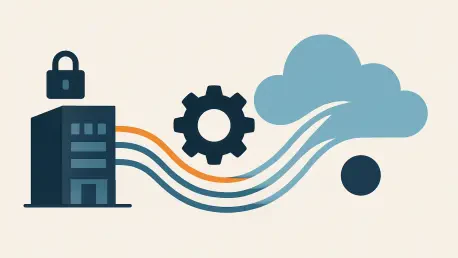

The long-held debate over public versus private cloud infrastructure has decisively concluded, not with a victory for one side, but with the strategic synthesis of both into a sophisticated and dominant model. By 2026, hybrid infrastructure has shed its reputation as a mere transitional phase and has firmly established itself as the deliberate, mature architectural choice for modern digital enterprises. This evolution is particularly evident in high-growth, high-stakes sectors such as fintech, media, and online gaming, where the ability to balance uncompromising performance, airtight security, cost efficiency, and stringent regulatory adherence is no longer a competitive advantage but a fundamental requirement for survival and success in a globally interconnected marketplace. The one-size-fits-all approach to cloud computing is now a relic of the past, replaced by a blended, optimized framework that offers the most sustainable path forward.
The New Architectural Blueprint
A Strategic and Purpose-Built Foundation
The adoption of hybrid infrastructure is no longer a reactive measure but a proactive and sophisticated architectural decision. Enterprises are now purposefully engineering their IT environments to capitalize on the distinct strengths inherent in both public and private cloud models, creating a tailored ecosystem that aligns directly with specific business objectives. This strategic approach is indispensable for supporting the complex demands of the modern digital economy, which includes handling high-volume financial transactions with absolute integrity, delivering latency-sensitive applications such as live betting dashboards with near-zero delay, and powering data-intensive artificial intelligence workloads that drive personalization and innovation. Moreover, this intentional design allows organizations to navigate the intricate web of data sovereignty laws and regulatory mandates, particularly in heavily regulated markets across North America and Europe, ensuring compliance without sacrificing agility or performance in a landscape where governance is paramount.
This strategic shift reflects a deeper understanding that different workloads have fundamentally different requirements. Rather than forcing all applications into a single cloud paradigm, organizations are logically segmenting their operations. Core business functions, sensitive customer data, and regulated processes are often housed within the secure, controlled confines of a private cloud or on-premise data center. This grants maximum oversight and control where it is most needed. Simultaneously, workloads characterized by variable demand, such as marketing analytics, seasonal traffic surges, or development and testing environments, are placed in the elastic and cost-effective public cloud. This nuanced allocation of resources is the hallmark of a mature hybrid strategy, transforming the IT infrastructure from a simple cost center into a dynamic and strategic enabler of business goals, providing a resilient foundation that is both secure and scalable enough to meet future challenges.
Key Technological Enablers
At the heart of today’s advanced hybrid environments lies a foundation built on containerization and orchestration, with technologies like Kubernetes serving as the essential connective tissue. This approach creates a standardized and abstracted application layer, decoupling services from the underlying infrastructure and enabling true workload portability. Applications can be developed once and seamlessly deployed or migrated across public and private clouds without requiring modification, a critical capability that effectively dismantles the risk of vendor lock-in. This operational consistency is a game-changer, allowing IT teams to manage a complex, distributed infrastructure with a unified set of tools and practices. It streamlines deployment pipelines, simplifies management, and ensures that the business can pivot its resources to the most suitable environment based on cost, performance, or compliance needs at any given moment, thus providing an unparalleled level of architectural flexibility and strategic freedom.
Complementing this core orchestration layer is the strategic integration of edge computing, which has become an indispensable component for optimizing performance and enhancing user experience. By extending the cloud infrastructure to nodes located physically closer to end-users, organizations can process data locally, drastically reducing the latency inherent in transmitting information back to a centralized data center. This is non-negotiable for real-time applications prevalent in sectors like online gaming, financial trading, and live media streaming, where even milliseconds of delay can impact outcomes and user satisfaction. Furthermore, the complexity of managing this distributed network of public, private, and edge resources is addressed through sophisticated automation platforms and unified monitoring tools. These systems provide a single pane of glass for comprehensive visibility, enabling consistent policy enforcement, proactive incident response, and efficient resource management across the entire hybrid estate.
Core Drivers: Security and Economic Sense
A Framework for Security and Compliance
The imperatives of robust security and unwavering regulatory compliance have emerged as primary catalysts for the widespread adoption of hybrid infrastructure. In industries where data integrity and privacy are paramount, such as iGaming, finance, and healthcare, adherence to a complex patchwork of regulations like data protection mandates, anti-money laundering rules, and state-level digital policies is non-negotiable. Hybrid architecture provides an elegant and practical solution by facilitating the logical and physical segregation of workloads. This allows organizations to house their most sensitive assets—including customer data, payment processing systems, and proprietary algorithms—within a private cloud or on-premise environment where they can exert maximum control over access and security protocols. At the same time, less sensitive, highly scalable workloads like marketing platforms or customer-facing web applications can leverage the agility and global reach of the public cloud, creating a secure yet flexible operational model.
This strategic partitioning of resources is powerfully reinforced by a suite of advanced security practices that have become industry standards. The implementation of zero-trust network architectures, which assume no user or device is inherently trustworthy, provides a foundational layer of defense. This is complemented by end-to-end data encryption, both in transit and at rest, ensuring that information remains indecipherable to unauthorized parties. Robust identity and access management (IAM) systems, fortified with multi-factor authentication, strictly govern who can access what resources. Layered on top of these preventative measures are sophisticated, AI-driven security systems that provide continuous monitoring and anomaly detection. These intelligent tools can proactively identify and neutralize emerging threats across the entire distributed environment, moving security from a reactive posture to a predictive and resilient one that protects the organization’s most critical assets.
The Dual Focus on Cost and Performance
The maturation of hybrid cloud has definitively dispelled the early, simplistic notion that the public cloud is invariably the cheapest option. Experience has shown that unmanaged or poorly architected public cloud deployments can lead to significant and unexpected cost overruns, a phenomenon often referred to as “bill shock.” Hybrid infrastructure directly confronts this challenge by enabling a far more economically logical and strategic allocation of IT resources. Enterprises now leverage advanced, real-time cost-management and analysis tools that provide granular visibility into consumption patterns across their entire hybrid estate. This data-driven insight empowers them to make informed, dynamic decisions about where to place specific workloads to achieve the optimal balance between cost and performance, transforming cloud spending from a reactive expense into a managed and predictable investment aligned with business value.
This balanced approach ensures that financial efficiency and performance optimization are treated as two sides of the same coin. The elastic, pay-as-you-go model of the public cloud is expertly utilized for workloads with variable or unpredictable demand, such as handling traffic spikes during major sporting events, accommodating seasonal marketing campaigns, or provisioning the immense computational power needed for training advanced AI models. Conversely, predictable, steady-state workloads with consistent, long-term resource requirements are often placed in a private cloud or on-premise infrastructure, where the total cost of ownership is frequently lower over time. By strategically placing applications in the environment best suited to their technical requirements—latency-sensitive services at the edge, large-scale analytics in hyperscale data centers, and stable core systems in private clouds—organizations not only control expenditures but also achieve superior operational performance and a demonstrably better end-user experience.
A Future-Ready, Integrated Ecosystem
Synergy with AI, Automation, and DevOps
The true transformative power of the modern hybrid model is realized through its deep, intrinsic integration with contemporary operational paradigms. Artificial intelligence and automation are no longer siloed add-ons but are fundamentally woven into the fabric of infrastructure management. AI-powered operational tools are now routinely used to analyze vast streams of system logs, accurately predict future capacity needs, and even autonomously recommend optimal workload placements to continuously balance cost, performance, and compliance criteria. This intelligent oversight mitigates the complexity of managing a distributed environment. In parallel, robust automation pipelines, governed by Infrastructure-as-Code (IaC) frameworks like Terraform and Ansible, ensure that applications and their underlying infrastructure are deployed consistently, reliably, and repeatably across the entire hybrid landscape, drastically minimizing the risk of manual errors and configuration drift.
This powerful synergy between intelligent infrastructure and automation is the bedrock that supports modern DevOps practices. It enables organizations to build and maintain sophisticated continuous integration and continuous deployment (CI/CD) pipelines that are essential for rapid and stable feature releases. Development teams can innovate faster, knowing that their code will be deployed seamlessly and consistently, regardless of whether the target environment is a private data center, a public cloud provider, or an edge location. This integration has been pivotal, allowing businesses to accelerate their development cycles, improve service reliability, and respond more swiftly to changing market demands. The result is a highly agile and resilient ecosystem where technology is not just supporting the business but actively driving its competitive edge through continuous innovation and operational excellence.
Positioned for Future Innovation
The hybrid framework that has now become standard was built not just for the needs of today but with an inherent adaptability that positions enterprises for the technological shifts of tomorrow. The journey to this point has established a flexible foundation capable of seamlessly incorporating emerging technologies and adapting to new operational challenges. Looking forward, the ever-increasing demand for real-time data processing and interactive applications will ensure that edge computing becomes an even more critical and integrated component of the hybrid ecosystem, pushing computational power and decision-making closer to where data is generated and consumed. This evolution will further enhance responsiveness and unlock new capabilities in areas like IoT, augmented reality, and autonomous systems, all managed within the cohesive hybrid framework.
Furthermore, the very success of these complex, distributed environments has created a new imperative for even more sophisticated management tools. This will drive an increased reliance on AI-powered management and observability platforms for predictive maintenance, autonomous optimization, and advanced security threat hunting. Concurrently, the global regulatory landscape is expected to become even more stringent, with an expansion of data sovereignty regulations that will further solidify the strategic necessity of hybrid models capable of guaranteeing data localization and compliance. The wider adoption of serverless functions within these architectures also promised to further optimize costs and enhance developer agility. The strategic decisions made to embrace a deliberate hybrid strategy have thus created a resilient and future-ready platform, one that is fully equipped to evolve with the next wave of innovation.