Imagine a world where data centers, the backbone of our digital lives, can’t keep up with the explosive growth of artificial intelligence and cloud demands—a world where inefficiency slows innovation. That’s the challenge Arm is tackling head-on, reshaping the very foundation of compute infrastructure with groundbreaking solutions. In today’s tech landscape, where AI workloads push hardware to its limits, Arm is pioneering a new era of data centers through what’s known as the converged AI data center model. This isn’t just about faster chips or bigger servers; it’s a complete rethink of how systems are designed, optimized, and scaled. By focusing on purpose-built architecture, Arm is driving a revolution that balances performance with power efficiency, catching the attention of the biggest players in the industry. This article dives into how Arm is leading this transformation, exploring its growing influence, the innovative converged model, and the broad industry shifts that are redefining the future of data processing on a massive scale.
Arm’s Rising Dominance in Data Center Design
Arm’s ascent in the data center realm is nothing short of remarkable, with projections indicating that nearly half of all compute shipped to major hyperscalers will rely on Arm architecture in the near future. This isn’t a distant dream but a reality unfolding now, as leading cloud providers pivot to Arm for its unique ability to deliver high performance without the hefty power costs. The shift signals a deeper change in infrastructure philosophy, moving from one-size-fits-all hardware to specialized systems crafted for the complex needs of AI and cloud-native tasks. Hyperscalers, which handle vast amounts of global data, are standardizing on Arm to ensure their operations remain scalable and sustainable. This growing adoption isn’t just about numbers; it reflects a trust in Arm’s vision to solve the pressing challenges of modern computing, setting the stage for a wave of innovation that’s already visible in cutting-edge deployments across the sector.
Take, for instance, the AWS Graviton5 processor, a shining example of Arm’s impact on real-world applications. Boasting 192 cores and a cache five times larger than earlier versions, Graviton5 offers up to 25% better performance for critical cloud workloads. What’s striking is the scale of adoption—over half of Amazon Web Services’ new CPU capacity has been Graviton-based for several years, with nearly all of their top 1,000 customers running it in production environments. This isn’t a niche experiment; it’s a fundamental shift in how cloud economics work, where performance gains outstrip increases in cost and energy use. Arm’s architecture underpins this transformation, proving that purpose-built solutions can meet the intense demands of today’s digital ecosystem while paving the way for more efficient, cost-effective data centers. The success of Graviton5 is a testament to how Arm is not just participating in the market but actively redefining what’s possible.
Unveiling the Converged AI Data Center Vision
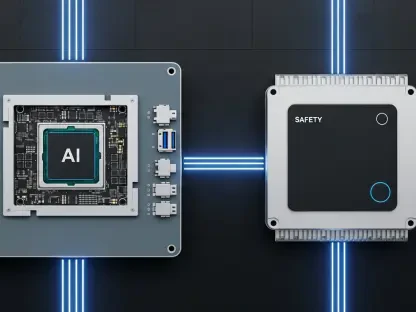
At the heart of Arm’s strategy lies the concept of the converged AI data center, a bold departure from the traditional, generic server setups of the past. Unlike older models that often struggled to adapt to specialized tasks, this approach integrates every piece of the puzzle—compute power, acceleration, networking, memory, storage, and software—into a single, harmonious system. Arm’s architecture serves as the critical link, enabling optimization across all layers while preserving the flexibility needed to handle diverse AI-driven workloads. This isn’t about slapping together faster components; it’s a holistic redesign that cuts down on power waste and boosts efficiency at every turn. The result is a data center that can keep pace with the relentless demands of machine learning and cloud services, offering a blueprint for scalability that’s already turning heads among industry giants looking to future-proof their operations.
Drilling deeper, the converged model assigns distinct roles to each component, creating a seamless workflow that maximizes output. CPUs, for example, oversee the control plane and execute essential logic, while accelerators take on the heavy lifting of computational tasks. Meanwhile, intelligent systems like SmartNICs, often built on Arm silicon, ensure data moves securely and efficiently across the network. This setup prioritizes “intelligence-per-watt,” a metric that underscores how much performance can be squeezed out of every unit of energy. By fostering such tight integration, Arm’s design accelerates innovation without sacrificing compatibility or disrupting existing software ecosystems. It’s a game-changer for data centers, providing a framework where speed and sustainability coexist, and it’s clear this model is setting a new benchmark for how infrastructure should be built to tackle the challenges of an AI-dominated digital landscape.
Industry-Wide Shifts and Collaborative Momentum
Arm’s influence isn’t confined to a single company or use case; it’s sparking a movement across the tech industry as major players align with its vision. From Google’s Axion processors to Microsoft’s Cobalt series powering Azure’s AI-optimized data centers, and even NVIDIA’s Grace Blackwell platform combining Arm CPUs with AI accelerators, there’s a clear consensus among hyperscalers and chipmakers. They’re restructuring their strategies around purpose-built compute, with Arm as the unifying thread that ties these advancements together. This isn’t just casual experimentation— it’s a calculated pivot to infrastructure that can handle the skyrocketing demands of modern workloads while keeping energy costs in check. The widespread adoption among these titans highlights how Arm’s solutions are becoming the de facto standard, reshaping not just individual data centers but the broader competitive landscape of cloud and AI technology.
Moreover, Arm’s reach extends far beyond the hyperscale giants to touch enterprise applications, edge computing, and even autonomous systems. Through forward-thinking programs like Arm Total Design and Arm Cloud Migration, the company is breaking down barriers, making cutting-edge compute accessible to organizations of all sizes. These initiatives democratize custom silicon design and ease cloud adoption, bringing hyperscale-level efficiency to smaller players who previously couldn’t compete on such a stage. This push reflects a larger trend toward inclusivity in tech, where advanced tools aren’t just for the biggest budgets but can empower a wide array of industries. Whether it’s enhancing AI inference at the edge or supporting intelligent networking, Arm’s principles are proving versatile, fueling a ripple effect that’s set to transform how data is processed and utilized across countless sectors in the years ahead.
Looking Back at a Transformative Journey
Reflecting on the strides made, Arm’s role in redefining data centers through the converged AI model stood as a pivotal chapter in tech history. The adoption of purpose-built silicon by industry leaders showcased a clear path toward balancing performance with sustainability, with processors like AWS Graviton5 setting benchmarks that reshaped cloud economics. The integration of infrastructure components into a unified system marked a departure from outdated designs, delivering efficiency that resonated across hyperscale and enterprise environments alike. Collaborative efforts with giants like Google, Microsoft, and NVIDIA underscored an industry-wide embrace of Arm’s architecture, while programs expanding access to custom design hinted at broader inclusivity. Moving forward, the focus should shift to scaling these innovations, ensuring smaller organizations and emerging fields like edge computing can tap into this momentum, and continuing to refine systems for even greater “intelligence-per-watt” as AI demands evolve.