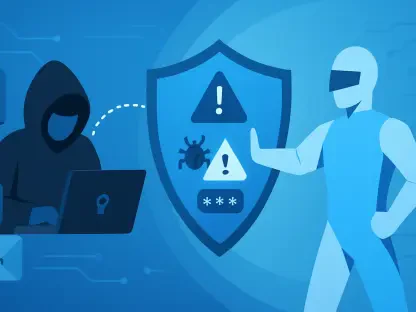

The modern digital landscape relies heavily on an intricate web of open-source dependencies that, while fostering rapid innovation, simultaneously create a massive and often invisible surface area for sophisticated cyberattacks. As 2026 progresses, security researchers have identified a specialized class of supply chain threats known as Cordyceps, named after the fungus that hijacks its host’s nervous system. Unlike traditional malware that seeks to destroy data, these attacks aim to subvert the software development lifecycle by infiltrating legitimate codebases. This represents a move toward parasitic longevity, where malicious logic remains undetected within a trusted application for months. The complexity is compounded by the sheer volume of transitive dependencies in modern frameworks, making it nearly impossible for human auditors to manually verify every line. Consequently, the speed of deployment often outpaces the rigor of security validation, leaving organizations vulnerable.
Tactics
Repos
Attackers employ a blend of social engineering and technical exploitation to gain access to widely used open-source libraries. One common tactic involves the slow infiltration of a project’s maintainer group, where a malicious actor contributes legitimate bug fixes over several months to build credibility before introducing a subtle vulnerability. This strategy ensures that the eventual malicious payload is merged into a signed release, bypassing traditional gatekeeping mechanisms. Furthermore, dependency confusion attacks have evolved in 2026 to target private registries by mimicking naming conventions of proprietary internal packages. When a build system queries for these names, it may pull a higher-versioned malicious package from a public repository instead of the intended private one. This method exploits the trust developers place in automated package managers. By the time the breach is discovered, the compromised code has often propagated to thousands of downstream consumers.
Build
Modern software delivery relies on automated continuous integration and deployment pipelines, which have become a primary vector for Cordyceps-style infections. In these environments, the compromise often occurs at the orchestration layer, where attackers target secrets stored within build runners. If an attacker gains access to a configuration, they can inject malicious steps that modify the compiled binary after the source code scan, rendering static analysis tools ineffective. This technique, often referred to as a compiler-level attack, ensures that the final artifact distributed to customers contains a backdoor that never existed in the original repository. Moreover, the increasing use of third-party GitHub Actions or shared scripts has expanded the threat surface. Many of these tools are not subjected to the same level of scrutiny as core code, yet they possess elevated permissions to write to production. This allows malware to persist quietly without triggering any security alarms.
Shields
Trust
To combat these threats, organizations have increasingly turned toward the implementation of a Software Bill of Materials (SBOM). An SBOM acts as a detailed inventory, documenting every library and transitive dependency utilized within an application. By 2026, the industry has recognized that visibility is the first step toward security, as it allows teams to quickly identify if they are running a version of a library that has been flagged as compromised. Cryptographic attestation has also become a standard requirement for high-security environments, ensuring that every piece of code can be traced back to a verified origin. Frameworks like Supply-chain Levels for Software Artifacts (SLSA) provide a structured approach to these validations. Implementing these standards requires a shift in organizational culture, moving away from a trust-by-default mindset to one where every dependency is treated as a risk. This transition is supported by tools that compare builds against attestations.
Policy
The response to these evolving threats required a fundamental re-evaluation of how software integrity was maintained across global networks. Leading technology firms established rigorous governance models that prioritized supply chain security over the sheer speed of feature delivery. These organizations adopted automated behavioral monitoring tools that analyzed the runtime actions of third-party libraries, allowing them to detect anomalies that traditional scanners missed. Security teams integrated deep-packet inspection and fine-grained access controls to ensure that even a compromised dependency could not communicate with unauthorized external servers. This proactive stance significantly reduced the impact of large-scale infiltration attempts throughout the latter half of 2026. The shift toward a shared responsibility model between maintainers and corporate consumers fostered a more resilient ecosystem. Ultimately, these measures transformed the supply chain into a robust framework where security was baked into the development lifecycle.