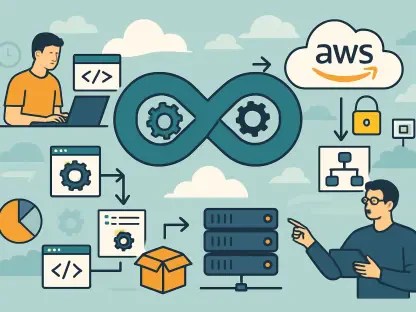

The persistent gap between a company’s strategic digital ambitions and its actual delivery capacity often stems from an invisible “maintenance trap” that consumes the majority of engineering resources. In the current landscape of 2026, many organizations find that despite significant investments in cloud infrastructure and modern tooling, their most talented developers remain tethered to the past, spending upwards of 80% of their time on patches, manual scaling, and emergency troubleshooting. This operational overhead creates a stagnation point where innovation is sacrificed for basic stability, rendering “digital transformation” a buzzword rather than a competitive reality. To break this cycle, leadership must recognize that velocity is not merely a product of faster coding, but a result of reducing the sheer volume of work required to keep the lights on. When the maintenance-to-innovation ratio is skewed toward the former, the organization is effectively subsidizing technical debt at the expense of its future market share. Successful transformation occurs only when DevOps is treated not as a secondary set of tools, but as a foundational operating model that reclaims engineering hours for high-value product development.
Traditional approaches to software delivery often suffer from the “illusion of busyness,” where teams are constantly active yet fail to move the needle on customer satisfaction or revenue. This discrepancy frequently arises because DevOps initiatives are misidentified as simple automation projects rather than holistic shifts in how value is produced and sustained. While implementing a continuous integration and deployment pipeline is a necessary step, it does not constitute a complete strategy if the underlying architecture remains fragile and demanding. In 2026, the industry has shifted toward measuring “deployment rework rates” alongside traditional speed metrics to capture the true cost of unplanned work and technical instability. By focusing on capabilities over maturity models, high-performing enterprises ensure that reliability is designed into the delivery process from the very first line of code. This systemic integration allows for smaller, safer releases that turn production environments into feedback loops, providing the real-time data necessary to pivot in a volatile global economy.
1. Remove Non-Essential Technical Burdens
In the competitive realm of enterprise commerce, a significant portion of daily infrastructure management is fundamentally undifferentiated and offers no unique competitive advantage to the brand. Tasks such as managing global server distribution, patching kernel vulnerabilities, and manual load balancing are essential for survival but do not distinguish a retailer from its rivals in the eyes of the consumer. When senior engineers are buried in these repetitive tasks, the organization pays a high opportunity cost, as these experts are prevented from building features that actually drive conversion and customer loyalty. To achieve a true digital transformation, technical leaders must perform a ruthless audit of their technology stack to separate bespoke engineering requirements from commodity services that can be offloaded. By shifting these non-essential burdens to managed platforms that handle hosting, security, and scaling automatically, a company effectively “shrinks” its operational surface area. This reduction in complexity is the first critical step in transitioning from a reactive maintenance posture to a proactive, innovation-focused development cycle.
The transition toward offloading undifferentiated heavy lifting is not merely a matter of convenience; it is a strategic necessity for maintaining agility in 2026 and beyond. Modern managed ecosystems have evolved to absorb the complexities of global compliance and performance optimization, allowing internal teams to treat infrastructure as a reliable utility rather than a constant project. This shift permits the engineering department to move away from being a cost center focused on “keeping the lights on” and toward becoming a value driver that responds to market shifts in real time. For instance, when a platform automatically manages peak-traffic events or security remediations, the internal DevOps team can focus on refining the “paved road” to production, making it easier for product teams to ship code without friction. This architectural simplification ensures that every dollar spent on engineering is directed toward the unique value propositions of the business. Consequently, the organization can scale its operations without a linear increase in headcount or maintenance costs, breaking the traditional bond between growth and operational complexity.
2. Redirect Engineering Efforts Toward Delivery Speed
Once the oppressive weight of platform maintenance is lifted, the primary focus of DevOps shifts from basic survival to the pursuit of extreme delivery speed and experimentation. With the “heavy lifting” handled by a robust foundation, engineers are finally free to engage in the kind of high-level problem solving that defines market leaders, such as personalizing user journeys or integrating advanced AI-driven recommendations. In this new environment, the cadence of product releases is no longer dictated by the fear of breaking a fragile backend or the need for lengthy code freezes during peak shopping seasons. Instead, teams can leverage their freed-up capacity to run more A/B tests, launch targeted marketing campaigns in days rather than months, and refine the user interface based on immediate feedback. This redirection of effort transforms the developer experience from one of frustration and “firefighting” to one of creativity and “storytelling.” By focusing on the elements that actually define the brand—the unique “joy and surprise” of the customer experience—the organization ensures that its technical output is directly aligned with its commercial goals.
This fundamental shift in engineering focus naturally leads to a culture of rapid iteration where the cost of failure is minimized and the speed of learning is maximized. In the current 2026 environment, market conditions can change overnight, and the ability to deploy a new feature or a tactical fix in minutes is a significant strategic asset. When the underlying platform handles the intricacies of the checkout flow and payment security, product teams can concentrate on building “delightful” interactions that build long-term brand equity. This stage of the transformation is characterized by the decoupling of operational stability from feature velocity; the platform provides the former, while the DevOps-empowered teams drive the latter. The result is a highly responsive organization that can capitalize on emerging trends faster than competitors who are still bogged down in custom-built infrastructure. By treating delivery speed as a core business metric, leadership can ensure that the technology department is acting as a force multiplier for the entire company’s growth strategy.
3. Multiply Progress Through External Partner Strengths
A common misconception in digital transformation is that an organization’s capacity is limited solely by its internal headcount and the hours its employees can work. In reality, the most successful enterprises in 2026 view their chosen technology platforms as an extension of their own team, effectively multiplying their impact through the vendor’s research, development, and engineering expertise. By leveraging the immense R&D investments of a specialized platform provider, a mid-sized company can access the same level of security, performance, and innovation as a global titan. This “flywheel effect” occurs when the external platform handles the expansion of complex functionalities—such as launching native mobile applications or expanding into new international markets—without requiring the company to hire dozens of new specialists. This synergy allows organizations to stay lean and focused, using their internal talent to direct the platform’s capabilities toward specific business objectives. The external partner acts as a massive engineering engine, providing the “heavy lifting” of platform evolution while the internal team provides the strategic direction and brand-specific customization.
Furthermore, leveraging the strengths of a robust ecosystem allows even small, independent retailers to compete on a global scale with established giants like Amazon or Walmart. When an organization utilizes a managed platform that continuously integrates the latest industry standards and technological advancements, it avoids the trap of building custom solutions that become obsolete within a few years. This approach ensures that the company is always at the cutting edge of commerce technology without having to invest billions in its own research and development. The ability to ship new features in minutes rather than months, powered by a platform that scales automatically to meet demand, creates a sustainable competitive advantage that is difficult to replicate through traditional custom-build approaches. This partnership model redefines the role of the CTO from a manager of infrastructure to a curator of strategic capabilities. By choosing the right partners, leaders can ensure that their organization is not just keeping pace with the industry, but actively setting the standard for digital excellence in their specific niche.
4. Track Meaningful Data by Linking Technical Metrics to Business Goals
To ensure that a DevOps-driven transformation is delivering genuine value, it is essential to move beyond vanity metrics and focus on data that connects technical performance to concrete business outcomes. While the four DORA metrics—deployment frequency, lead time for changes, change failure rate, and time to restore service—are excellent indicators of a healthy delivery pipeline, they do not tell the whole story. In 2026, the most effective organizations correlate these technical statistics with lagging business indicators such as conversion rates, revenue per session, and the speed of campaign launches. For example, if a team manages to double their deployment frequency but the conversion rate remains stagnant, it suggests that the organization is merely “moving faster in the wrong direction.” This alignment requires a shared language between the engineering and marketing departments, ensuring that every technical improvement is aimed at solving a specific customer problem or capturing a market opportunity. By monitoring these linked datasets, leadership can identify whether their investments in DevOps are translating into a superior customer experience and improved financial performance.
This integrated measurement strategy also serves as a diagnostic tool for uncovering hidden bottlenecks that technical metrics alone might miss, such as inefficient decision-making processes or misaligned organizational structures. If the data shows that the technology stack is fast and stable but the business is still slow to react to competitors, the problem likely lies in the communication layers between product management and engineering. Effective digital transformation requires that “speed to market” becomes a cross-functional KPI, where the success of a feature is measured by its impact on the bottom line rather than just its presence in a production environment. Moreover, this focus on meaningful data prevents the organization from over-optimizing delivery mechanics at the expense of strategic flexibility. By constantly validating technical progress against business reality, the organization can maintain a balanced approach to transformation that values both operational excellence and commercial agility. Ultimately, this data-driven mindset ensures that the DevOps journey is a continuous cycle of improvement that yields measurable returns for the entire enterprise.
The transition from a maintenance-heavy legacy environment to a high-velocity digital leader requires more than just the adoption of new software; it demands a fundamental shift in how engineering effort is valued and applied. In 2026, the most successful organizations have moved past the initial hype of DevOps and have begun to master the art of platform leverage and organizational alignment. By following a structured roadmap that prioritizes the removal of operational burdens and the redirection of talent toward innovation, companies can finally escape the maintenance trap that has historically stifled digital initiatives. The final stage of this journey involves maturing the measurement systems to ensure that technical speed always serves the broader business strategy, creating a sustainable loop of growth and adaptation. Organizations that act now to simplify their foundations and empower their teams will find themselves well-positioned to lead their respective markets, while those who remain tethered to the complexities of the past will likely see their competitive advantages continue to erode. The path forward is clear: stop managing infrastructure and start building the future.