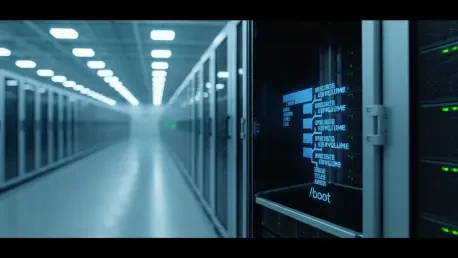

In a significant architectural evolution aimed at modernizing its cloud offering, the Fedora Project has officially approved a plan to eliminate the traditional separate ext4 partition for the /boot directory in its upcoming Cloud 44 release. This long-standing practice, a remnant of historical bootloader limitations, is being replaced by a more flexible and efficient Btrfs subvolume integrated directly into the main root filesystem. The decision, formally greenlit by the Fedora Engineering and Steering Committee (FESCo) on December 10, 2025, represents a deliberate move to streamline storage management, reduce image overhead, and address persistent pain points in virtualized and cloud-native environments. This change not only enhances the technical foundation of Fedora Cloud but also reinforces the project’s commitment to pioneering the adoption of advanced open-source technologies for the modern data center.
Ditching the Past Why the Separate Boot Partition Had to Go
The Problem of Fixed-Size Partitions
The traditional approach of dedicating a separate, fixed-size partition for /boot has long been a source of operational friction in dynamic cloud environments. This design creates a rigid container for essential boot files, including kernel images and initial RAM disks (initramfs). As systems undergo regular updates, new versions of these files accumulate, steadily consuming the finite space allocated to the partition. This inevitably leads to space contention, a scenario where the /boot partition becomes completely full, causing critical system updates to fail with the infamous “No space left on device” error. For system administrators managing large, automated fleets of virtual machines, this is more than an inconvenience; it is a significant operational bottleneck. Resolving the issue requires manual intervention to either prune old kernels or perform a complex and risky partition resize operation, tasks that run counter to the principles of automation and seamless scalability that define modern cloud infrastructure. This inherent rigidity transforms a routine maintenance task into a potential source of downtime and administrative overhead.
Beyond the immediate risk of update failures, the very existence of a separate boot partition introduces inefficiencies that are particularly pronounced in the world of cloud computing. Every byte matters in base cloud images, which are designed to be as compact as possible for rapid provisioning and efficient storage. The separate /boot partition contributes to image bloat, adding unnecessary overhead and increasing the initial disk footprint of every deployed instance. This contradicts the modern paradigm of starting with minimal images that are dynamically expanded as needed. Furthermore, the presence of a second partition complicates the entire image creation and deployment lifecycle. It necessitates additional formatting and mounting steps during the provisioning process, which can slow down automated CI/CD pipelines and introduce another potential point of failure. In an ecosystem that values minimalism, speed, and simplicity, the separate boot partition stands out as an anachronistic complication that adds complexity without providing proportional benefits in a cloud context.
A Modern Solution with Btrfs Subvolumes
The transition to a Btrfs subvolume for the /boot directory presents a far more elegant and practical solution that directly addresses the shortcomings of a separate partition. By consolidating the boot directory into the main Btrfs filesystem, this approach effectively eliminates the concept of a fixed-size container for boot files. Btrfs subvolumes function much like independent directories but have the critical advantage of sharing the total available storage space of the underlying filesystem. This simple yet powerful change immediately resolves the long-standing problem of a full /boot partition. Instead of being constrained by a small, predetermined allocation, the /boot subvolume can now draw from the much larger pool of space available to the root filesystem, ensuring that kernel updates can proceed without being hampered by artificial space limitations. This consolidation also yields the immediate benefit of smaller base cloud images and a more streamlined management process, as the need to create, format, and manage a second partition is entirely removed from the provisioning workflow.
The most compelling advantage of using a Btrfs subvolume, however, lies in its unique ability to combine the flexibility of a shared storage pool with the benefits of independent management. A key feature of this implementation is that the /boot subvolume can be explicitly excluded from system-wide Btrfs snapshots. This is a crucial detail for maintaining efficient and lean system backups. Snapshots of the root filesystem, which are vital for atomic updates and system rollbacks, will not be bloated by the contents of the boot directory, which contains large kernel images that change with every update. This architecture effectively provides the logical isolation benefits that a separate partition was intended to offer, but without its rigid and problematic size constraints. It delivers the best of both worlds: /boot remains a distinct, manageable entity that can be handled separately from the rest of the OS, while simultaneously benefiting from the fluid and dynamic space allocation of the main storage pool, perfectly aligning with the flexible resource management required by modern cloud infrastructure.
A Strategic Move with Broader Implications
Aligning with the Future of Fedora
This architectural shift is far from an isolated technical tweak; it represents a key part of a broader, deliberate strategy to unify and advance the entire Fedora ecosystem. By extending Btrfs as the default filesystem to the Cloud Edition’s boot process, Fedora solidifies Btrfs’s position as its strategic choice for storage across all its major editions. This move builds upon the successful adoption of Btrfs as the default for Fedora Workstation since Fedora 33, leveraging its now-proven stability and rich feature set in a new domain. The result is a more consistent and feature-rich experience for users and developers, whether they are working on a local desktop or deploying applications in the cloud. This consistency simplifies management and reduces the learning curve for users operating across different Fedora environments. More importantly, it reinforces Fedora’s reputation as a vanguard in the Linux community, one that is unafraid to adopt and thoroughly vet advanced technologies before they become mainstream in enterprise-grade distributions, thereby pushing the entire open-source ecosystem forward.
Furthermore, the integration of the boot process into the main Btrfs filesystem synergizes perfectly with the project’s significant investment in immutable operating systems, such as Fedora Silverblue, Kinoite, and CoreOS. These modern OS variants are fundamentally designed around the concept of atomic updates and reliable rollbacks, a capability powered directly by Btrfs snapshots. By bringing /boot into this snapshot-managed environment as a subvolume, the architecture strengthens the integrity and reliability of the entire atomic update model. It creates a more cohesive system where the boot environment is managed with the same modern tooling as the root operating system, enhancing the overall reproducibility and robustness of the system. This alignment is especially critical in cloud deployments, where predictability, reliability, and the ability to safely roll back from a failed update are paramount for maintaining service availability and operational stability. This change thus serves to harden the foundation upon which Fedora’s next-generation, immutable platforms are built.
Technical Hurdles and Rollout Plan
Executing such a fundamental change to the storage layout required careful technical planning and implementation. The transition necessitated significant updates to Fedora’s image-building toolchain, specifically within the Kiwi framework and its associated fedora-kiwi-descriptions repository. These tools had to be modified to ensure that newly generated cloud images would be created with the Btrfs subvolume configuration by default, replacing the legacy partitioned layout. Beyond the image creation process, developers also had to ensure seamless compatibility with the GRUB bootloader. While GRUB has mature support for reading from Btrfs, specific edge cases had to be addressed to guarantee a flawless boot experience. For instance, a bug related to GRUB’s hidden menu feature and its environment block file (grubenv) was identified and resolved to prevent potential boot failures, demonstrating the project’s commitment to a polished and reliable end-user experience from the very first boot.
To ensure maximum stability and avoid platform-specific compatibility issues, the new storage layout will not be universally applied across all Fedora Cloud image types. The project has taken a cautious approach, excluding certain architectures and boot configurations from this change. Notably, images designed for UEFI-UKI (Unified Kernel Image) environments and those for the s390x architecture will retain the traditional separate boot partition due to their unique boot loader requirements and hardware constraints. This targeted rollout strategy minimizes risk and ensures that platforms with specialized needs are not negatively impacted. It is also crucial for existing users to understand that this change is not an in-place upgrade. Fedora Cloud instances currently in operation will not be automatically migrated to the new layout. To take advantage of the simplified storage architecture, administrators will need to deploy fresh cloud images built with the Fedora 44 release, highlighting the community’s need for clear and comprehensive documentation to guide users through this transition smoothly.
Setting a New Standard
This forward-thinking decision has done more than just improve a single distribution; it has solidified Fedora’s reputation as a key innovator in the Linux ecosystem. By field-testing and successfully implementing this modern storage architecture, Fedora has once again served as a proving ground for technologies that are later adopted by enterprise-grade distributions, including Red Hat Enterprise Linux. The move was poised to create ripple effects across the competitive landscape, placing pressure on other major distributions like Ubuntu and SUSE to evaluate and potentially accelerate their own Btrfs integrations for cloud-native solutions to remain competitive. This architectural refinement reflected a wider industry trend where the advanced features of Btrfs, such as copy-on-write, checksums, and integrated snapshotting, were gaining significant traction. These capabilities were increasingly seen as essential for building the resilient, “bulletproof” systems that modern cloud and edge computing environments demand, a sentiment echoed by other distributions and technology publications.
Ultimately, Fedora Cloud Edition 44’s shift to a Btrfs subvolume for /boot was a calculated and forward-thinking architectural refinement. It was not merely a minor technical adjustment but a strategic move that harmonized the operating system’s storage layout with the fluid, scalable, and efficiency-driven demands of modern cloud computing. By eliminating the rigid and outdated separate boot partition, Fedora successfully reduced base image sizes, simplified system management, and enhanced overall resilience through a deeper integration with Btrfs’s advanced features. While challenges related to implementation and user adoption were carefully managed, the change represented a significant step toward a more efficient, robust, and manageable foundation for cloud infrastructures. In doing so, it established a potential new best practice for boot management in distributed systems across the open-source spectrum.