
The convergence of sophisticated cyber-attacks and the relentless pace of software delivery has forced a fundamental transformation in how modern engineering teams approach security within their deployment cycles. In 2026, the traditional model of treating security as a final checkpoint before release has become a liability, often resulting in costly delays or, worse, the deployment of vulnerable code that can be exploited in minutes. Organizations now recognize that the only way to maintain a high velocity of innovation without compromising safety is to embed security protocols directly into the heart of the development process. This integration, known as DevSecOps, leverages the power of automated platforms like GitHub Actions and Azure to create a “secure by default” environment where vulnerabilities are identified and remediated before they ever leave the developer’s workstation. By treating security as a continuous thread rather than an afterthought, teams are able to build more resilient applications while simultaneously reducing the cognitive load on individual engineers who no longer have to guess about the compliance of their changes.
1. Foundations of a Modern Automated Security Architecture
The core philosophy of a modern DevSecOps pipeline is the absolute necessity of automated verification at every stage of the software development lifecycle. Rather than relying on manual reviews that are prone to human error and oversight, the pipeline serves as an impartial arbiter of code quality and safety, ensuring that every commit meets the rigorous standards defined by the organization. This automated approach is designed to provide immediate feedback to developers, allowing them to correct issues while the context of their changes is still fresh in their minds. Central to this strategy is the concept of the “breaking build,” where the pipeline is explicitly configured to stop the deployment process if any high-risk security flaws are detected. This prevents the progression of insecure code to higher environments, effectively acting as a digital firewall that protects the production infrastructure from internal weaknesses.
Beyond simple error detection, these pipelines foster a culture of transparency and shared responsibility across the entire technical organization. When security checks are baked into the GitHub Actions workflow, they become a visible part of the development experience rather than a hidden process managed by a separate silo. This transparency allows for a more collaborative approach to problem-solving, where security specialists and software engineers work together to refine the automated rules and scanning logic. As a result, the organization moves away from a reactive posture—scrambling to patch live vulnerabilities—and toward a proactive stance that prioritizes the integrity of the codebase from the very first line of code written. This architectural foundation is what enables businesses to scale their cloud operations on Azure with the confidence that their growth is not creating an unmanageable surface area for potential attacks.
2. Navigating the Multi-Stage Development Workflow
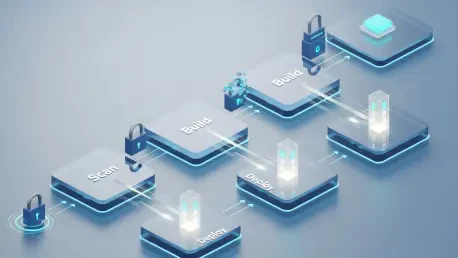
The execution of a secure pipeline follows a precise, sequential workflow designed to balance speed with thoroughness, starting with a multi-pronged analysis that runs as soon as a pull request is initiated. The first three stages of this process—Static Application Security Testing (SAST), secrets detection, and dependency auditing—are typically executed in parallel to maximize efficiency and provide the fastest possible feedback loop. SAST utilizes advanced engines like CodeQL to perform a deep semantic analysis of the source code, searching for structural patterns that often indicate vulnerabilities such as cross-site scripting or database injection flaws. Simultaneously, specialized tools like Gitleaks scan the entire repository’s commit history to ensure that no developer has accidentally committed sensitive information, such as API keys or connection strings, which are frequently targeted by malicious actors looking for easy entry points into cloud environments.
Once these initial security scans are cleared, the pipeline moves into the functional validation phase, where the application code is compiled and subjected to a suite of automated unit and integration tests. This stage is crucial because it ensures that the security enhancements or bug fixes introduced in the current iteration do not break existing functionality or introduce regressions. Following a successful build and test cycle, the application is deployed to an Azure App Service staging slot, a mirror of the production environment that allows for non-disruptive “smoke testing” in a live cloud context. This multi-layered approach ensures that by the time a release is ready for the final production environment, it has already been validated against security policies, functional requirements, and environmental compatibility, drastically reducing the risk of a failed or compromised deployment.
3. Advanced Implementation of Security Scanning Tools
Deep integration of security tooling requires more than just enabling a plugin; it involves fine-tuning the scanning logic to distinguish between manageable risks and critical threats. For instance, when configuring CodeQL within a GitHub Actions workflow, it is essential to establish clear thresholds that determine when a build should be blocked. Teams often decide to halt the pipeline only for “high” or “critical” findings to avoid overwhelming developers with false positives or low-priority alerts that can be addressed during regular maintenance windows. This nuance ensures that the security pipeline remains a helpful tool rather than a frustrating bottleneck. Furthermore, the effectiveness of secrets detection is heavily dependent on how the scanning engine accesses the code history; a common best practice is to perform a full clone of the repository to ensure that even “buried” secrets in historical commits are identified and rotated.
In addition to internal code analysis, managing the security of external libraries is a vital component of the DevSecOps strategy in 2026. Since modern applications are built upon a vast ecosystem of third-party dependencies, tools like Snyk or the native “npm audit” functionality must be used to continuously monitor for newly discovered Common Vulnerabilities and Exposures (CVEs). This scanning shouldn’t just happen during a code push; instead, the pipeline should be configured to run on a recurring schedule, such as every weekend, to check for vulnerabilities that may have been discovered in existing code that hasn’t changed in months. This proactive monitoring ensures that the application remains secure against an evolving threat landscape where a library that was considered safe on Friday could be flagged as a critical risk by Monday morning.
4. Operational Excellence in Deployment and Traceability
Moving code from a staging environment to a live production setting requires a combination of automated precision and human oversight to maintain operational integrity. GitHub Environments play a pivotal role here by allowing organizations to define specific protection rules, such as requiring a manual approval gate from a senior engineer or a security lead before the final deployment step is triggered. This human-in-the-loop requirement serves as a final sanity check, ensuring that all previous automated tests were passed and that the business is ready for the new version to go live. In the Azure ecosystem, the use of deployment slots allows for a zero-downtime transition, where the staging slot is swapped with the production slot in a matter of seconds. This mechanism not only provides a seamless experience for end-users but also offers an immediate rollback path if an unforeseen issue is detected in the live environment.
Traceability is the final pillar of a robust DevSecOps pipeline, providing the necessary audit trail to understand exactly what was deployed, by whom, and when. Every action taken within the GitHub pipeline, from the initial code scan to the final slot swap in Azure, should be automatically logged and exported to a centralized monitoring service like Azure Monitor. These logs contain vital metadata, including the specific commit hash and the identity of the person who provided the manual approval, creating an immutable record of the software supply chain. This level of detail is indispensable for compliance audits and incident response, as it allows teams to quickly trace a production issue back to a specific set of code changes or a particular deployment event. By maintaining this high standard of observability, organizations can confidently manage complex cloud architectures while meeting the stringent regulatory requirements of the modern digital economy.
5. Mitigating Common Weaknesses in Pipeline Configuration
Despite the availability of advanced tools, many organizations still fall victim to avoidable configuration errors that undermine the effectiveness of their DevSecOps pipelines. One of the most prevalent mistakes is the use of shallow Git clones during the scanning phase, which only downloads the most recent version of the code rather than the entire history. This oversight allows secrets that were committed in the past and then “deleted” in a subsequent commit to remain active and accessible to anyone with access to the repository’s history. To fix this, the workflow must explicitly set the “fetch-depth” to zero, ensuring the scanning engine has visibility into every change ever made. Another frequent error involves the improper storage of sensitive variables; rather than using standard environment variables that might be exposed in logs, teams must utilize encrypted GitHub Secrets to handle credentials and connection strings safely.
Furthermore, teams often struggle with “vulnerability fatigue,” where a large number of low-severity issues are allowed to accumulate because they do not trigger a build failure. Over time, this security debt can become a significant risk, as multiple minor flaws can sometimes be chained together by an attacker to gain unauthorized access. A successful DevSecOps strategy involves a commitment to cleaning up these minor issues during scheduled maintenance cycles rather than letting them linger indefinitely. Additionally, bypassing deployment gates for “hotfixes” is a dangerous practice that often leads to the introduction of vulnerabilities under the pressure of a crisis. Maintaining a strict policy where every change, regardless of its urgency, must pass through the full automated pipeline and manual approval process is the only way to ensure that the production environment remains consistently protected.
6. Strategic Outcomes of Proactive Pipeline Security Management
By the time the final deployment swap was completed in Azure, the application had undergone a rigorous gauntlet of automated and human validations that ensured its safety. The integration of CodeQL and Gitleaks provided a robust defense against common coding errors and the accidental exposure of sensitive credentials, while the use of Azure App Service slots guaranteed a smooth transition for the user base. This systematic approach allowed development teams to focus on creating value, knowing that the infrastructure itself was acting as a vigilant guardian of the codebase. The transition to this automated model moved the organization away from the high-stress, error-prone releases of the past and toward a predictable, repeatable process that prioritized security at every turn.
Implementing these strategies proved that security and speed are not mutually exclusive but are instead complementary components of a high-performing engineering culture. The visibility provided by GitHub Environments and the detailed logging in Azure Monitor established a level of accountability that was previously unattainable. Moving forward, teams were encouraged to continue refining their scanning queries and dependency schedules to adapt to the ever-shifting landscape of cyber threats. By treating the pipeline as a living product that requires continuous improvement, the organization ensured that its security posture remained sharp. The ultimate realization was that the investment in automated DevSecOps not only protected the company’s assets but also empowered developers to move faster with the certainty that their work was built on a secure and stable foundation.