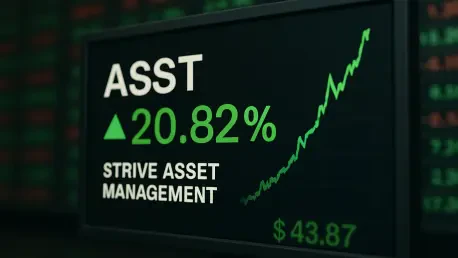

Corporate financial engineering can often trigger powerful and immediate market reactions, and Strive Asset Management provided a textbook example as its stock experienced a dramatic single-day climb. Following the strategic implementation of a reverse stock split, shares of the company (ASST) vaulted an impressive 20.82%, a move that instantly captured the attention of traders and analysts alike. While such a maneuver mechanically increases the price per share without altering the company’s overall market capitalization, the resulting psychological impact on the market can be profound. This sudden surge has placed Strive under a microscope, forcing investors to look beyond the impressive percentage gain and question whether this is the start of a sustainable recovery driven by renewed confidence or merely a fleeting, cosmetic adjustment. The market’s initial euphoria now gives way to a period of intense scrutiny, as the focus shifts from the technical action to the underlying financial health and future prospects of the business.
The Mechanics and Market Reaction
A Calculated Corporate Maneuver
The significant upward movement in Strive’s stock was the direct result of a carefully orchestrated 1-for-20 reverse stock split that became effective on February 6. This corporate action consolidated every 20 existing shares of both Class A and Class B common stock into a single, higher-priced share. The procedure also necessitated the issuance of a new CUSIP number for the security and required corresponding adjustments to be made for all outstanding options contracts, ensuring all derivatives accurately reflected the new share structure. According to the company’s Chief Investment Officer, the primary rationale behind this decision was to elevate the per-share price to a level that aligns with “institutional participation standards,” a common strategy used by companies to attract larger, more stable investors who may be prohibited from or are hesitant to invest in lower-priced stocks. In a related development that signaled broader positive sentiment, the company’s Series A perpetual preferred stock (SATA) also experienced a notable 7.5% gain, suggesting that the market’s initial reaction extended beyond just the common stock.
Interpreting the Immediate Aftermath
The market’s response to the reverse split was swift and decisive, with the stock closing at a split-adjusted price of $11.915, reflecting the substantial 20.82% surge. This immediate price appreciation highlights a key psychological aspect of reverse splits: a higher nominal share price can often be perceived as a sign of greater stability and value, even though the company’s fundamental valuation remains unchanged. For many retail and institutional investors, a stock trading in the double digits carries more weight and credibility than one trading for pennies or a few dollars. The initial rally suggests that traders are, at least for now, betting that this maneuver will succeed in its goal of repositioning the stock in the eyes of the market. However, seasoned analysts remain cautious, viewing this initial spike as a predictable, short-term reaction. The true test will unfold in the subsequent trading sessions, which will reveal whether this enthusiasm is a sustainable shift in investor sentiment or simply a temporary ripple from a purely technical adjustment to the company’s capital structure.
Navigating an Uncertain Future
Scrutiny on Liquidity and Institutional Interest
As the initial excitement from the price surge subsides, the market’s attention is now pivoting to critical long-term performance indicators, chief among them being trading volume and liquidity. A common and significant risk associated with reverse stock splits is a subsequent decrease in the number of shares being traded daily. With fewer shares available in the public float, liquidity can dry up, leading to wider bid-ask spreads and increased price volatility. This potential outcome stands in direct contrast to the company’s stated objective of attracting more stable, institutional buyers. Investors will be closely monitoring trading patterns in the coming weeks to determine if the higher share price successfully draws in the intended institutional capital or if the reduced share count inadvertently makes the stock less attractive for active trading. The central question is whether the “institutional participation standards” are met by the new price alone, or if these larger investors will require stronger evidence of fundamental business health before committing significant capital to the newly repriced equity.
External Influences and Upcoming Catalysts
Beyond the direct consequences of the reverse split, Strive’s future stock performance is intrinsically linked to several external factors and upcoming corporate events that investors are carefully weighing. A critical element to consider is the stock’s known correlation with the highly volatile cryptocurrency market. The performance of major digital assets like Bitcoin could exert significant influence on Strive’s share price, potentially overriding the technical effects of the split and introducing a layer of market risk beyond the company’s direct control. Furthermore, an important near-term catalyst is the scheduled dividend payment for the SATA preferred stock on February 15. This event will serve as a tangible indicator of the company’s financial stability and its commitment to shareholder returns. For traders and analysts, this dividend payment will be a key data point, offering a glimpse into the company’s cash flow and overall operational health, and its successful execution could help solidify the fragile confidence that the reverse split initially generated in the market.
A Pivotal Moment of Observation
The immediate, sharp rise in Strive’s stock price marked a tactical victory for the company’s reverse split strategy. The maneuver successfully lifted the share price into a range more palatable to institutional investors, generating a powerful wave of initial optimism. However, the completion of this corporate action did not mark an end, but rather the beginning of a crucial observational period. The focus for investors and analysts had shifted decisively from the technical execution of the split to its real-world consequences. The true measure of success was to be found in the subsequent trading weeks, where sustained interest from institutional funds, stable or increasing trading liquidity, and the company’s fundamental performance would ultimately dictate the stock’s long-term trajectory. The market’s initial positive reaction had given way to a more cautious, wait-and-see approach, with the understanding that future value would be built on tangible results, not financial restructuring.