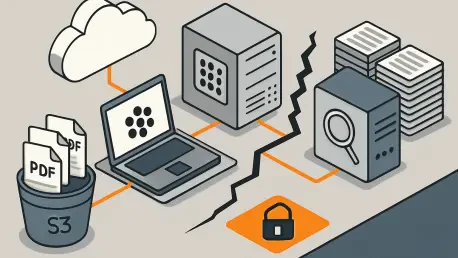

The initial charm of building a Retrieval-Augmented Generation (RAG) system often masks a looming technical debt that remains invisible until the first thousand documents become ten million. In a typical pilot phase, a developer might simply pipe a few PDFs into an Amazon S3 bucket, trigger a script to generate embeddings via Amazon Bedrock, and shove the resulting vectors into an OpenSearch cluster. This “happy path” works brilliantly for a demonstration, yet it frequently crumbles under the weight of real-world corporate requirements where data consistency and security are non-negotiable.
The industry is currently witnessing a massive pivot from experimental AI to what many call the “Platform Era” of embedding management. As organizations move beyond the proof of concept, they realize that treating a vector database like a simple utility is a recipe for operational disaster. Scaling on AWS requires more than just more compute power; it necessitates a rigorous, platform-centric approach that treats vector data as a volatile, high-maintenance asset rather than a static record. This shift ensures that as demand grows, the system remains a reliable source of truth rather than an unpredictable liability.
Beyond the Proof of Concept: The Hidden Complexity of Vector Data
While connecting a document repository to a vector database might seem straightforward during a pilot phase, the transition to enterprise-scale RAG often reveals deep systemic vulnerabilities. Many organizations treat their vector store as a simple utility, only to find that as data volume and user demand grow, the system becomes unpredictable and difficult to govern. Scaling successfully on AWS requires moving past the basic pipeline and adopting a rigorous platform-centric approach. This shift ensures that vector data remains a reliable asset rather than an operational liability.
The transition to production involves moving from a single-use script to a persistent infrastructure capable of handling “drift.” In the corporate ecosystem, data is rarely static; documents are updated, retracted, or reclassified hourly. If the underlying embedding store cannot synchronize these changes with millisecond precision, the RAG system begins to provide answers based on “ghost” data—information that no longer exists in the source but persists in the vector index. This divergence creates a trust gap that can derail even the most sophisticated AI initiatives.
The Volatility of Vectors: Managing a Corporate Ecosystem
Unlike a relational database where a price or a name remains constant across systems, a vector is a fragile artifact of a specific technical pipeline. It is inextricably linked to the embedding model version, the chunking strategy, and the preprocessing steps applied at the moment of creation. If any of these variables change, the resulting vector shifts, potentially breaking retrieval logic even if the source text remains the same. In an enterprise environment, this leads to “silent quality erosion,” where the system continues to return answers, but their accuracy gradually declines without triggering traditional error logs.
Furthermore, as multiple departments begin sharing the same AWS infrastructure, the risk of “spontaneous multi-tenancy” arises. Imagine a scenario where a human resources bot and a legal research tool share the same OpenSearch index. Without strict isolation, data from one team might leak into the queries of another. This isn’t just a technical glitch; it is a significant compliance failure. Modern AWS architectures must prioritize the isolation of these mathematical representations to ensure that the “context window” of the LLM is populated only by data the specific user is authorized to see.
Reliability: The Pillar of Advanced Service Level Agreements
Standard uptime metrics are insufficient for RAG; the platform must guarantee performance across the entire data lifecycle. Relying on the fact that a server is “up” tells a developer nothing about whether the retrieval quality is actually functional. To combat this, enterprise leaders are implementing latency standardization, specifically targeting P95 and P99 metrics for vector searches. This prevents unoptimized, high-dimensional queries from degrading the user experience for everyone else on the shared cluster.
Data freshness mandates have also become a cornerstone of the modern embedding store. It is no longer acceptable for a document to take hours to become “searchable” after being uploaded to S3. Defining a “time-to-retrievable” goal ensures that the pipeline is optimized for speed and that 95% of updates are indexed within minutes. Moreover, quality stability monitoring through “golden query” sets allows teams to measure Recall@K. By running these automated tests, a platform can ensure that a model update in Bedrock does not cause a sudden regression in the relevance of the retrieved text.
Robust Governance: Data Provenance and Security
To maintain security and auditability, every vector must carry a “birth certificate” that tracks its origin and permissions. Metadata-rich indexing is the only way to manage this at scale. By recording the S3 URI, the specific embedding model ID, and the exact chunking configuration for every stored vector, administrators can facilitate selective rebuilds. If a specific version of a model is found to be biased or hallucination-prone, the platform can identify and re-index only the affected chunks rather than nuking the entire database.
Server-side access control represents another critical evolution in governance. Rather than trusting the application layer to filter out sensitive results—a method prone to prompt injection and coding errors—the platform layer should automatically inject mandatory security filters into every OpenSearch request. This ensures that the vector store itself acts as a firewall. Coupled with comprehensive audit trails that link user identities with the specific chunks they accessed, organizations gain a forensic trail essential for debugging incidents or satisfying regulatory inquiries.
Economic Controls: Managing Costs and Attribution
Vector search operations, particularly embedding calls via Amazon Bedrock, can lead to runaway costs if not strictly managed. A single bug in a synchronization script can trigger a re-indexing of a million documents, resulting in a massive, unexpected bill. To prevent these “ingest storms,” enterprise platforms must implement strict quotas on tokens and documents. By setting daily limits, the infrastructure protects the budget from poorly optimized loops or unintended data dumps.
In addition to ingest limits, rate limiting on queries is essential for maintaining fair resource distribution. Implementing queries-per-second caps per tenant ensures that a single department’s aggressive testing doesn’t starve a production-facing application of resources. Cost showback reporting then provides internal departments with granular visibility into their storage and compute footprint. When teams see the direct financial impact of their data management choices, they are far more likely to adopt efficient chunking strategies and purge stale information.
Expert Perspectives: Preventing RAG Failure Modes
Industry experts highlight that the most common cause of RAG failure at scale is the “data swamp” effect, where unmanaged indices become cluttered with stale or redundant information. Research into high-performing AWS architectures suggests that the most resilient systems utilize a “Platform Boundary” that abstracts raw services from the end-user. By implementing canary indices for testing new embedding models and enforcing strict Time-to-Live policies for documents, organizations avoid the infinite storage growth that often plagues unmanaged clusters.
Experience shows that neutralizing information leakage at the infrastructure level, rather than the application level, is the only way to satisfy enterprise compliance requirements. Architects often suggest a modular framework that starts with a document intake layer using S3 event triggers to automate text extraction. This is followed by a centralized embedding pipeline that routes all vector generation through a managed service. Finally, a protected query service acts as the sole gateway, handling natural language translation and security filter injection before the raw database is ever touched.
The path forward required a fundamental transition in how technical teams perceived the relationship between data and models. Instead of viewing the vector store as a passive bucket, successful organizations treated it as an active participant in the inference chain. They deployed modular architectures designed for isolation, ensuring that every retrieval was not only fast but also contextually accurate and legally defensible. By centralizing the embedding pipeline and enforcing platform observability through AWS Cognito and IAM, businesses turned their raw infrastructure into a sophisticated, governed ecosystem. Moving forward, the focus shifted toward proactive index maintenance and the use of automated quality gates to prevent the slow decay of retrieval precision. This disciplined approach eventually transformed the “data swamp” into a streamlined engine for reliable enterprise intelligence.