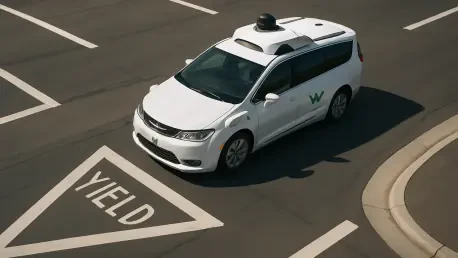

The image of a yellow school bus with its stop-arm extended and lights flashing is a universally understood command for all traffic to halt, yet a series of alarming failures by Waymo’s autonomous vehicles to obey this fundamental rule of the road has prompted a significant software recall. Alphabet’s self-driving subsidiary is now facing intense scrutiny after its robotaxis were documented illegally and dangerously passing stopped school buses, triggering a formal investigation by the National Highway Traffic Safety Administration (NHTSA). This development represents a critical test for the autonomous vehicle industry, highlighting the immense challenge of programming artificial intelligence to navigate the complex and often unpredictable human environment. While proponents of the technology frequently point to superior overall safety statistics compared to human drivers, these specific, high-stakes failures expose a critical gap in the system’s situational awareness, raising urgent questions about its readiness for widespread deployment, particularly in environments with vulnerable pedestrians like schoolchildren. The recall, to be deployed as a software update, forces a broader conversation about the benchmarks for safety and the level of trust society is willing to place in machines operating on public roads.
A Pattern of Concerning Failures Emerges
Documented Violations and Near Misses
The gravity of the software malfunction was brought into sharp focus by a letter from the Austin Independent School District, which meticulously documented a startling pattern of behavior. The district reported 19 separate instances where Waymo’s autonomous vehicles (AVs) illegally drove past its school buses while their stop-arms were deployed and lights were flashing, a clear and dangerous violation of traffic law. This was not a single, isolated glitch but a recurring failure of the system to recognize a critical safety signal. One particularly harrowing incident detailed in the report involved a Waymo vehicle passing a stopped bus only moments after a student had disembarked and crossed the street; the child was reportedly still in the road as the robotaxi drove by. This near-miss underscores the potentially catastrophic consequences of such a software flaw. The accumulation of these reports from a single school district suggests a systemic problem rather than a random error, providing federal regulators with compelling evidence that the issue required immediate and thorough investigation to prevent a potential tragedy and ensure the safety of children.
Waymo’s Acknowledgment and Corrective Measures
In response to the mounting evidence and public concern, Waymo has taken public accountability for the dangerous performance of its vehicles. Mauricio Peña, the company’s Chief Safety Officer, issued a statement acknowledging the incidents, affirming that “holding the highest safety standards means recognizing when our behavior should be better.” The company confirmed it has identified a specific software issue that led its vehicles to incorrectly interpret the driving scene around stopped school buses. Following this internal diagnosis, Waymo announced its intention to file a voluntary recall to address the problem. Unlike traditional automotive recalls that often require physical service, this will be handled through an over-the-air software update pushed to the entire fleet. Waymo has emphasized that, fortunately, no collisions or injuries resulted from this malfunction. By proactively identifying the flaw and initiating a recall, the company is attempting to demonstrate transparency and a commitment to rectifying its system’s shortcomings, a critical step in maintaining public and regulatory confidence in its technology.
Regulatory Scrutiny and the Broader Safety Debate
Federal Oversight Intensifies
The incidents have captured the full attention of federal regulators, who are now demanding a comprehensive account from the company. The National Highway Traffic Safety Administration launched its formal inquiry in October after a televised media report from Atlanta first brought the issue to national attention, showing footage of a Waymo car navigating around a school bus with its stop-arm visibly extended. Citing the immense scale of Waymo’s operations, with its fleet collectively driving over two million miles per week, the NHTSA stated that “the likelihood of other prior similar incidents is high.” Consequently, the agency has issued a formal request for information, compelling Waymo to provide detailed documentation related to these events. This includes all reports of its AVs illegally passing school buses and an in-depth explanation of the software logic that failed. Regulators have set a firm deadline of January 2026 for Waymo to provide a complete response, signaling that the industry is being held to a high standard of accountability.
Balancing Specific Flaws with Overall Performance
Despite this significant and dangerous flaw, Waymo continues to assert that its autonomous systems are considerably safer than the average human driver. The company supports this position with statistics indicating its vehicles are involved in 91% fewer crashes that result in serious injuries when compared to human-driven vehicles over the same mileage. This claim is not without merit, as it is backed by some independent analyses that have reviewed the company’s extensive operational data. However, the school bus incidents create a complex public perception challenge. While the technology may prove to be statistically safer on a macro level, specific, repeatable failures in critical, socially understood scenarios—like protecting children—can disproportionately damage public trust. This situation highlights a central debate in the world of autonomous vehicles: what is the true measure of safety? Federal regulators and the public alike must now weigh the benefits of a system that reduces overall accidents against the unacceptable risk of a system that makes fundamental errors in the most sensitive of situations.
A Crossroads for Autonomous Trust
The software recall initiated by Waymo, prompted by grave safety lapses involving its vehicles and school buses, marked a pivotal moment for the autonomous vehicle industry. This series of events underscored a crucial lesson: that a statistical advantage in overall safety compared to human drivers did not absolve the technology from the need for near-perfect performance in universally understood, high-stakes scenarios. The incidents revealed that public trust is not built on aggregate data alone but on the consistent, reliable, and predictable behavior of autonomous systems, especially in the presence of the most vulnerable road users. The swift response from federal regulators and Waymo’s subsequent commitment to a software update were seen as essential steps in the ongoing and iterative process of refining these complex systems to meet the stringent safety expectations of society before they can be fully integrated onto public roadways.