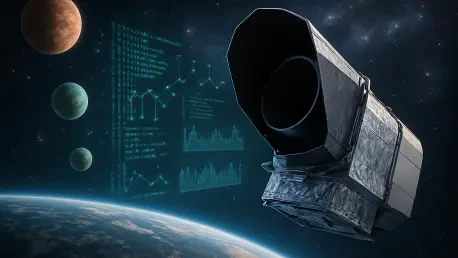

The Nancy Grace Roman Space Telescope’s groundbreaking mission to directly image planets orbiting other stars is receiving a significant boost, not from new hardware, but from sophisticated software enhancements designed to sharpen its vision and streamline its scientific output. A new initiative led by Jason Wang of Northwestern University will adapt and upgrade two powerful open-source astronomical software tools, pyKLIP and orbitize!, to support the Roman Coronagraph Instrument. This effort aims to refine every stage of the exoplanet discovery process, from selecting the most promising targets to analyzing the faint light reflected from these distant worlds. By leveraging these established and community-trusted packages, the project ensures that Roman’s complex data can be processed with state-of-the-art techniques, maximizing the mission’s potential to characterize planets beyond our solar system and paving the way for future observatories.
Enhancing Observational Capabilities
The success of the Roman Coronagraph Instrument hinges on its ability to perform incredibly precise observations and process the resulting data with unmatched accuracy. The proposed software development directly addresses these core requirements by creating a robust framework for managing the entire observational workflow. This involves not only telling the telescope where to look but also providing the tools to interpret the incredibly faint signals it will collect.
Streamlining Target Selection and Data Processing
A critical upgrade will focus on the orbitize! software, transforming it into a predictive tool for the Roman mission. By enhancing its functionality to forecast the future positions of known exoplanets with high precision, the tool will become indispensable for efficient mission planning. This allows the science team to schedule observations when a target planet is at its most visible separation from its blindingly bright host star, maximizing the chances of a successful detection. Furthermore, these predictions will help identify which celestial targets require supplementary ground-based observations to refine their orbits, ensuring that Roman’s valuable time is used on the most promising candidates. This strategic approach to target selection is fundamental to optimizing the scientific return of the coronagraph, which is designed to be a technology demonstrator for future, more ambitious missions. The ability to meticulously plan an observation schedule based on reliable orbital data is a game-changer for high-contrast imaging.
The project will also heavily invest in optimizing pyKLIP, a powerful algorithm already recognized for its superior performance in processing simulated Roman data during the Exoplanet Imaging Data Challenge. The planned improvements are designed to push its capabilities even further. A key enhancement involves incorporating orbital motion as a prior constraint within the detection framework, a sophisticated technique that helps the algorithm more effectively distinguish the faint, consistent signal of a planet from residual noise and instrumental artifacts. This is crucial for teasing out the light from planets that are billions of times fainter than their stars. Additionally, the software will be specifically adapted to handle data from the Coronagraph’s spectroscopic mode. This adaptation will enable scientists to not only detect these distant worlds but also begin to analyze the chemical composition of their atmospheres by studying the spectrum of their reflected light, offering the first clues about their nature.
Calibrating the Instrument for Peak Performance
Drawing upon a decade of expertise with high-contrast imaging instruments on the world’s leading ground-based telescopes, Jason Wang will also contribute significantly to the characterization of the Roman Coronagraph’s on-orbit performance. This work involves creating specialized, pyKLIP-based data pipelines and comprehensive tutorials designed to rigorously assess the instrument’s sensitivity to detecting planets of different brightness and at various separations from their star. By simulating and processing realistic data, the team can establish reliable performance benchmarks and fine-tune processing strategies before the telescope even begins its primary science operations. This proactive approach is vital for understanding the instrument’s inherent limitations and capabilities. Furthermore, the effort will help develop robust astrometric and spectrophotometric calibration strategies, ensuring that every measurement of a planet’s position and brightness is as accurate as possible, which is essential for determining its orbit and physical properties.
The ultimate goal of this initiative extends to demonstrating the full scientific potential of the Roman Coronagraph. This will be achieved by creating end-to-end workflows capable of extracting key scientific measurements from the raw data. These workflows will guide researchers through the process of measuring an exoplanet’s photometry (its brightness), astrometry (its precise position over time), and spectral properties. A particularly significant planned upgrade to the orbitize! package involves adding the functionality to simultaneously constrain a planet’s orbital parameters along with its phase function—how the planet’s brightness changes as it moves through its orbit. This dual analysis is a crucial step for accurately characterizing worlds seen in reflected light, as it helps disentangle the planet’s size and atmospheric reflectivity from the geometry of its orbit, providing a much clearer picture of the exoplanet itself.
A Commitment to Open Science and Future Missions
A core tenet of this project is its unwavering commitment to open and reproducible science, ensuring that its benefits extend far beyond the immediate Roman science team. By integrating these advanced capabilities into publicly available, open-source software packages, the initiative empowers the entire global astronomical community to engage with and analyze data from the mission.
Fostering Collaborative and Reproducible Research
The integration of these advanced data analysis tools into well-documented, publicly accessible software packages represents a foundational step toward ensuring the Roman Coronagraph’s legacy. This approach not only provides the immediate mission team with the necessary resources for its technology demonstration but also equips the broader astronomical community with the means to independently verify results and explore the data in novel ways. The development of these tools will be an ongoing process, matured and refined for the specific purpose of analyzing visible-light coronagraphic data from a space-based observatory. This effort is not just about building software for a single mission; it is about cultivating a powerful and versatile data analysis ecosystem that will become a standard for the field. The accessibility of these tools lowers the barrier to entry for researchers worldwide, fostering a more collaborative and innovative scientific environment where discoveries can be more easily shared, scrutinized, and built upon.
Paving the Way for the Next Generation of Telescopes
This software development work had a forward-looking perspective, with direct and significant applicability to future flagship missions. The algorithms, pipelines, and techniques refined for the Roman Coronagraph were designed to serve as a crucial stepping stone for its successors, most notably the planned Habitable Worlds Observatory (HWO). The HWO’s primary goal of searching for signs of life on Earth-like exoplanets will require even more advanced data processing capabilities to detect and characterize these incredibly faint targets. The foundation laid by the enhancements to pyKLIP and orbitize! provided the HWO development team with a proven, flight-tested software framework, which drastically reduced development time and mitigated risks for that future mission. The lessons learned and the community of expert users built around these tools proved invaluable, ensuring that the next generation of observatories began their quest with the most powerful analytical resources ever developed for exoplanet science.