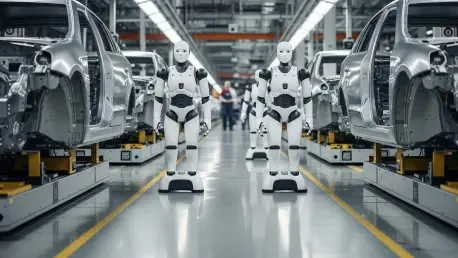

Automotive manufacturing is currently witnessing a historic transition as the Renault Group moves beyond the experimental phase of robotics to implement a full-scale industrial deployment of humanoid machines. This strategic pivot, central to the company’s “futuREady” initiative, involves the integration of 350 humanoid robots into active production environments over the next 18 months. While the industry has long relied on stationary robotic arms for welding and painting, this new wave of automation focuses on “brownfield” integration, which involves placing advanced, mobile technology into existing factory layouts originally designed for human movement. By avoiding the need to build entirely new facilities from scratch, the company is demonstrating a pragmatic approach to modernization that respects the legacy of its current infrastructure while aggressively pursuing the efficiencies offered by autonomous bipedal systems. This massive rollout serves as a clear signal that the era of humanoid prototypes is ending, replaced by a period of practical, large-scale application in the heart of the global automotive sector.
The move signifies more than just a technological upgrade; it represents a fundamental rethinking of how human-centric workflows can be augmented rather than replaced. These robots are not being deployed as a futuristic novelty but as a solution to specific operational bottlenecks that have historically resisted traditional automation. By targeting environments where space is at a premium and the floor plan is irregular, the initiative addresses the limitations of wheeled or fixed robotics. This deployment is expected to set a new benchmark for the industry, pushing other manufacturers to consider how humanoid forms can solve logistical challenges in factories that were never meant for rigid, traditional machinery. As these 350 units take their places on the assembly lines, they will provide a wealth of data on the viability of human-robot collaboration in high-pressure industrial settings, potentially redefining the standard operational model for vehicle assembly across the globe.
Engineering the Calvin Platform for Industrial Mobility
The technical foundation of this ambitious rollout is the Calvin-40, a sophisticated humanoid robot developed through a strategic partnership and investment in the robotics firm Wandercraft. Drawing on Wandercraft’s deep expertise in creating self-balancing medical exoskeletons, the Calvin platform possesses a level of stability and fluid movement that is rare in the industrial sector. This medical heritage is a critical advantage, as it allows the robot to maintain its balance while carrying heavy loads across the uneven and often cluttered floors of an active manufacturing plant. Unlike traditional robots that require a perfectly level and sanitized environment, the Calvin family is designed to thrive in the “organized chaos” of a brownfield factory. Its bipedal design allows it to step over obstacles and navigate narrow walkways that would be impassable for wheeled automated guided vehicles or bulky stationary platforms.
Beyond simple locomotion, the engineering behind the Calvin-40 focuses on the synergy between physical hardware and sophisticated control algorithms. These robots utilize advanced sensors to map their surroundings in real time, allowing them to adjust their gait and posture based on the weight of the objects they are handling. This capability is essential for maintaining safety in a shared workspace where human operators are constantly moving. The partnership with Wandercraft has enabled Renault to skip years of fundamental research into balance and gait, instead focusing on the specific actuators and end-effectors needed for automotive tasks. By leveraging a platform that was originally intended to help humans walk, the company has secured a robotic workforce that inherently understands the spatial requirements of a human environment, making the integration process significantly smoother than previous attempts at high-level factory automation.
Practical Applications in Ergonomics and Heavy Lifting
Currently, the most prominent application of the Calvin platform is found at the Douai plant in France, where these humanoid units are tasked with tire-handling operations. This specific role was selected because it represents one of the most physically demanding and repetitive tasks in the assembly process, often leading to long-term musculoskeletal strain for human workers. By assigning these heavy lifting duties to humanoid robots, the company is effectively mitigating ergonomic risks while maintaining a consistent and predictable production rhythm. The robot’s ability to mimic the human reach and grip allows it to pick up tires and position them with precision, fitting perfectly into the same physical footprint that a human operator would occupy. This prevents the need for the wide safety cages or massive floor-space reallocations that usually accompany the introduction of heavy industrial machinery into an existing assembly line.
This focus on ergonomic relief highlights a shift in corporate philosophy, where technology is used to augment the workforce by removing “dull, dirty, and dangerous” tasks from the daily routine of human employees. The robots act as a bridge between full manual labor and the high-speed, fixed automation seen in other parts of the plant. Because the Calvin robots can be easily reprogrammed or moved to different stations as production needs change, they offer a level of versatility that fixed automation lacks. For instance, if a specific line experiences a surge in volume, additional humanoid units can be deployed to assist with material handling without the need for extensive downtime or infrastructure modifications. This adaptability ensures that the factory remains responsive to market fluctuations, all while protecting the health and safety of the human staff who remain essential to the more complex and nuanced aspects of vehicle assembly.
Operational Intelligence through the Digital Thread
One of the most transformative aspects of the humanoid deployment is the role these robots play as mobile data nodes within the “digital thread” of the manufacturing process. Every Calvin unit is equipped with a suite of AI-driven sensors and high-definition cameras that do more than just facilitate navigation; they constantly capture data about the environment and the components they handle. This information is streamed back to a centralized system, where it is used to populate digital twins—virtual replicas of the physical factory. Managers can use this real-time visibility to identify bottlenecks, monitor the health of the robotic fleet, and optimize logistics in a way that was previously impossible with static sensors. The robot becomes a wandering eye that provides a ground-level perspective on factory efficiency, turning the act of moving a part from point A to point B into a valuable data-gathering exercise.
This connectivity supports a closed-loop quality control system where the data gathered by the robots on the floor can be used to make immediate adjustments to the manufacturing process. For example, if a robot detects a consistent slight misalignment in a batch of parts during handling, that information can be automatically fed back to the upstream production station to correct the issue before it leads to waste. This integration of physical labor and digital intelligence ensures that the entire factory operates as a single, synchronized organism. By leveraging the AI capabilities of the Calvin platform, the company is moving toward a model of “predictive manufacturing,” where potential issues are identified and resolved by the system itself. This digital transformation does not just improve the speed of production; it enhances the overall quality and consistency of the final product by ensuring that every movement on the factory floor is accounted for and optimized through advanced analytics.
Future Considerations for Precision and Quality Assurance
As humanoid robots become a permanent fixture on the factory floor, their role is expected to expand from simple material handling into the sophisticated realms of metrology and quality assurance. The mobility of the Calvin platform creates a unique opportunity to integrate inspection technologies directly into the transport process, effectively turning every robot into a mobile quality laboratory. Instead of moving a component to a specialized measurement room, the robot can perform preliminary dimensional checks or surface inspections using onboard sensors while in transit. This shift toward “in-line” metrology reduces the time between production and verification, allowing for much faster feedback loops. To support this, there is a growing demand for rugged, high-precision measurement tools that can function accurately despite the vibrations and movements inherent in a robotic gait, pushing the boundaries of what current inspection hardware can achieve.
Looking forward, the successful integration of these 350 units provides a roadmap for how global manufacturing sectors can balance rapid technological advancement with the realities of existing infrastructure. Companies should prioritize the development of flexible, AI-driven assets that can operate alongside humans without requiring the complete reconstruction of their facilities. The next logical step involves the standardization of communication protocols between different robotic platforms and inspection systems to ensure a seamless flow of information. Manufacturers should also invest in retraining their workforce to manage and maintain these complex robotic fleets, shifting human roles from manual labor to high-level system oversight. By embracing the humanoid form as a practical tool rather than a futuristic concept, the industry can achieve a new level of operational agility that is both economically viable and socially responsible, paving the way for a more resilient and efficient manufacturing future.