
In the relentless pursuit of artificial intelligence dominance, organizations are funneling unprecedented resources into acquiring the most sophisticated models and powerful hardware, operating under the assumption that technological superiority is the key to success. However, a growing cohort of enterprises is confronting a starkly different reality: the most formidable barriers to successfully scaling AI are not embedded in code or algorithms but are instead found within team structures, organizational processes, and deeply ingrained company cultures. This misalignment creates a fundamental paradox for executive leadership, especially for Chief Information Officers. Business units, driven by the immense potential of AI, are innovating at a breakneck pace, while CIOs are left to grapple with the monumental risks this new wave of technology introduces. The primary fear is the insidious rise of “Shadow AI”—a chaotic, unmanaged ecosystem of disparate AI tools and applications being used by employees, which echoes the “Shadow IT” crisis of the early cloud computing era but carries potentially catastrophic consequences due to its ability to process and expose sensitive corporate data. The conventional, centralized IT model, in which business departments submit requirements and await solutions built by a separate tech team, is proving far too cumbersome and slow for the AI age. Faced with these delays, employees who are keenly aware of the capabilities of public tools like ChatGPT and Claude will inevitably seek their own solutions, leading to an ad-hoc, unsecure landscape where innovation is dangerously intertwined with unmonitored risk.
Shifting the Focus from Tech to People and Process
The Human Element at the Core
The most crucial realization for organizations aiming for enterprise-wide AI adoption is that the endeavor is fundamentally a people and operating model challenge, with technology playing a secondary role. The true difficulty lies not in acquiring advanced models but in bridging the long-standing, deep-seated gap between information technology departments and business units. IT teams possess the technical expertise but often lack the nuanced business context, while business units have profound domain knowledge but are deficient in technical skills. The traditional, linear handoff of requirements between these two siloed groups is notoriously slow and prone to losing critical context at each stage, resulting in AI solutions that are technically sound but fail to meet real-world business needs. This structural inefficiency is the primary bottleneck preventing organizations from translating AI potential into tangible value. Success, therefore, hinges on restructuring how people collaborate, redefining roles, and building new organizational frameworks that prioritize direct, continuous interaction over sequential processes. The ultimate goal is to close this chasm by creating an environment where technology and business expertise are fused rather than separated.
To effectively bridge this divide, a strategic move toward the democratization of AI development is essential. This approach recognizes that the employee who is closest to a specific workflow—whether a procurement specialist who intimately understands supply chain logistics or a marketing analyst who lives and breathes customer data—is often the best-equipped individual to envision and create an AI agent that can optimize that process. Empowering these domain experts to build their own solutions is not merely about providing access to new tools; it is a fundamental shift in organizational philosophy. It requires a concerted effort to equip these employees with user-friendly, low-code platforms, comprehensive training on responsible AI principles, and a set of robust, pre-configured guardrails that allow them to innovate safely and responsibly. This model moves away from the idea that innovation is the exclusive domain of a centralized tech department and instead fosters a culture where problem-solving is distributed throughout the organization. By empowering the edges of the enterprise, companies can unlock a new wave of highly relevant, context-aware AI solutions that would never have emerged from a traditional, top-down development pipeline.
Reimagining Governance as an Enabler
For decades, IT governance has been characterized by manual review boards, intricate approval processes, and a series of compliance checkpoints that function as gates, slowing down or halting projects. In the context of rapid AI development, this traditional approach has become a significant impediment to innovation. It creates a culture of frustration, where development teams view governance not as a protective measure but as an obstacle to be circumvented. This adversarial relationship often encourages employees to seek out unapproved tools and shadow systems to avoid the bureaucratic delays, which paradoxically increases the very risks the governance model was designed to mitigate. The slow, reactive nature of these manual reviews is fundamentally incompatible with the iterative, fast-paced nature of AI development, turning governance into a bottleneck that stifles creativity and prevents the organization from capturing value quickly. The system intended to ensure safety and compliance ends up being a primary driver of unsafe and non-compliant behavior, forcing a radical rethink of its entire purpose and structure.
The modern, effective approach to AI governance requires a paradigm shift, transforming it from a series of restrictive gates into an enabling framework that facilitates safe speed. This is achieved by embedding governance directly into the core technology platform, making it an “invisible infrastructure” that supports rather than hinders development. Instead of subjecting every project to a lengthy manual review, this model automates compliance checks, provides pre-approved and secure access to curated data sources, and instantly provisions sandboxed development environments where teams can experiment without jeopardizing production systems. By building the rules of the road directly into the highway, governance becomes a facilitator of progress, ensuring that every AI agent created adheres to security and privacy standards by default. This embedded approach not only empowers teams to innovate with confidence but also provides boards and executives with centralized, real-time visibility into the organization’s entire AI portfolio, allowing them to understand and proactively manage the aggregate risk profile without slowing down the pace of innovation.
Building the Blueprint for Safe and Scalable AI
The Foundational Enterprise Platform
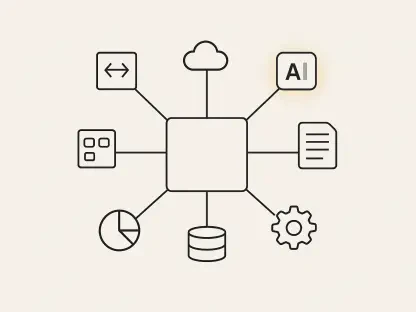
The successful implementation of embedded governance and the safe democratization of AI development both depend on a crucial piece of infrastructure: a “hyper-opinionated” enterprise AI platform. This concept goes far beyond a simple collection of software tools or access to various AI models. It represents a curated, standardized, and highly controlled infrastructure that serves as the single, approved pathway for all AI development within the organization. Such a platform is meticulously designed to integrate a selection of vetted AI models with the company’s most critical assets, including enterprise data sources, productivity suites like M365, and core business systems such as CRMs and ERPs. Every component is pre-configured to work together seamlessly and securely. This deliberate standardization is not about limiting choice for the sake of control; rather, it is a strategic decision to create a unified and coherent ecosystem that eliminates technological fragmentation and ensures that all AI development activities adhere to a consistent set of security, compliance, and architectural standards from the outset.
The strategic value of this centralized platform approach is twofold, simultaneously addressing the core challenges of speed and security. First, it acts as a powerful accelerator for development. By providing pre-built, secure integrations to essential data and systems, the platform eliminates the need for each individual team to solve complex and redundant technical problems, such as authentication, data access protocols, and API management. This allows them to focus their energy on solving the actual business problem, drastically reducing the time it takes to move from an idea to a deployed, value-generating AI agent. Second, and equally important, the platform fundamentally enhances the organization’s security posture. By channeling all AI development and traffic through a known, monitored, and managed infrastructure, it eliminates the blind spots created by Shadow AI. This ensures that every AI agent operates within established security perimeters and that all data interactions are logged and auditable, giving security and compliance teams the comprehensive visibility they need to protect the enterprise in an era of rapidly expanding AI usage.
IBM’s Practical Innovations
One of the most effective governance mechanisms for enabling this broad, democratized approach to AI is the implementation of an “AI License to Drive.” This internal certification framework functions much like a standard driver’s license, ensuring that any employee wishing to build and deploy AI agents possesses a baseline level of competency and awareness. The training curriculum covers essential principles of data privacy, information security standards, and the correct, approved protocols for connecting AI agents to backend enterprise systems and sensitive data repositories. By requiring this certification, an organization can confidently empower employees from any department—be it finance, HR, or marketing—to innovate with AI tools. This model effectively scales risk mitigation by distributing responsibility and knowledge throughout the workforce. It mitigates the primary dangers associated with uncontrolled AI development, such as accidental data leakage, the creation of security vulnerabilities, and the proliferation of unsupported “rogue” agents that are eventually abandoned, leaving the IT department to manage the resulting technical debt and security risks.
To directly address the operational inefficiencies and skill gaps inherent in traditional development workflows, a new operating model known as “AI Fusion Teams” has emerged as a powerful solution. These hybrid groups break down the historical silos between business and technology by co-locating business domain experts with skilled IT technologists in a single, integrated unit. This structure collapses the long, inefficient chain of handoffs that typically occurs—from a business expert to a product manager, then to a designer, and finally to an engineer—where critical context and accuracy are often diluted or lost. In this new paradigm, the business expert, armed with foundational skills like prompt engineering, takes an active role in building the AI solution directly on the enterprise platform. Concurrently, the IT technologist acts as a deep technical advisor, focusing on complex backend integrations, creating robust APIs, and ensuring the final solution is secure, scalable, and maintainable. This direct, continuous collaboration ensures that the AI agent is tightly aligned with real-world business requirements and accelerates the delivery of tangible value from months to weeks.
Cultivating a Culture for Long-Term Success
Measuring What Matters and Monitoring for Change
To effectively scale artificial intelligence, organizations must evolve how they measure success, shifting their focus from tracking simple outputs to evaluating tangible business outcomes. It is insufficient to simply count the number of AI agents deployed; value must be demonstrated through core business metrics. Use cases can be categorized to apply appropriate frameworks: everyday productivity tools, such as email summarizers, save individual time but are difficult to link to broad financial outcomes. In contrast, end-to-end agentic workflows designed to automate entire processes must be measured against key performance indicators like revenue growth, improvements in operational efficiency, or measurable reductions in per-unit cost. Furthermore, applications focused on risk reduction or compliance management require a different set of metrics centered on mitigating exposure or ensuring adherence to regulations. A centralized platform is instrumental in this effort, as it enables granular cost tracking, allowing leaders to see the daily expenditures of specific AI use cases and make data-driven decisions about which initiatives to scale, optimize, or retire based on their demonstrated return on investment.
Unlike traditional software, which remains relatively static after deployment, AI models are dynamic systems whose performance can “drift” over time. This degradation can be caused by a variety of factors, including updates to the underlying model, changes in the data sources it relies on, or evolving patterns in user interaction. An AI agent that performs exceptionally well during testing can produce different, less accurate, or even harmful results just weeks later in a production environment. This inherent dynamism necessitates a fundamental shift in mindset from a conventional “deploy and maintain” software lifecycle to a more vigilant “deploy and continuously monitor” approach. Organizations must implement robust instrumentation and governance tools to track key performance metrics—such as the resolution rate for a customer support agent—and solicit user feedback in real time. This continuous monitoring allows teams to detect performance drift as it happens and intervene to correct it before it negatively impacts business operations, erodes user trust, or incurs unforeseen costs, ensuring the long-term viability and reliability of the AI solutions.
Redefining Work in the Age of AI
Perhaps the most profound and difficult challenge in scaling enterprise AI is not technical or operational but cultural. For generations, organizational cultures have celebrated and rewarded “working hard,” a value often measured through visible proxies like long hours, constant availability, and sheer manual effort. Artificial intelligence fundamentally disrupts this paradigm by automating much of the tedious, time-consuming work that once served as a measure of employee dedication. This requires a deliberate and thoughtful redefinition of what constitutes value within the organization. Leaders must actively cultivate a new culture that rewards “working smart”—that is, leveraging AI to achieve superior outcomes with significantly less manual effort. This transition involves more than just introducing new tools; it requires directly addressing employee fears about job security and obsolescence by reframing AI as a collaborative partner that augments human expertise rather than a technology that replaces it.
This cultural transformation had to be driven from the top down, with leaders championing a new set of values that prioritize innovation, efficiency, and strategic thinking over brute-force effort. Praising an employee for working through a weekend to manually fix a problem that could have been prevented or automated with AI inadvertently reinforces the old, unproductive cultural norms. True success in the AI era will be defined by an organization’s ability to foster a workforce that embraces these new tools to elevate their own capabilities. The goal was to create an environment where employees are encouraged to offload repetitive tasks to AI agents, freeing up their cognitive capacity to focus on higher-value activities such as complex problem-solving, strategic planning, and building deeper customer relationships. This deliberate cultural shift was not just a byproduct of successful AI adoption; it was a critical prerequisite for unlocking its true, transformative potential.