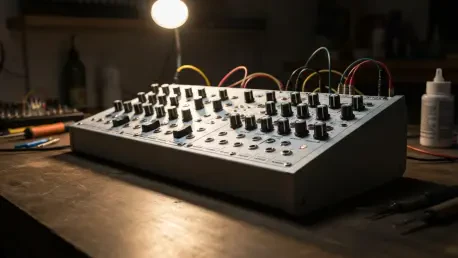

In the ever-expanding universe of electronic music hardware, a persistent dilemma confronts musicians: the choice between a self-contained, standalone synthesizer with a fixed architecture and the boundless, yet often complex, world of modular synthesis. A new contender, the Shmøergh Moduleur, has emerged from the workshop of Peter Zimon and “Flame,” the minds behind the Shmøergh Hog mono synth, offering a compelling resolution to this dichotomy. This open-source, do-it-yourself (DIY) analog modular synthesizer presents itself not merely as another instrument, but as a comprehensive platform built on a philosophy of deep customization and user modification. It skillfully blurs the lines between a boutique, all-in-one device and a fully integrated component of the wider modular ecosystem. This innovative approach invites both seasoned electronics enthusiasts and adventurous musicians to explore a synthesizer that is as much a creative project as it is a professional-grade musical tool, promising an unparalleled level of personalization and sonic exploration from the circuit board up.
A Bridge Between Two Worlds
The initial impression of the Shmøergh Moduleur is that of a meticulously crafted, cohesive instrument rather than a collection of disparate parts. Its physical construction features a robust, thick aluminum chassis with a durable powder-coated and UV-printed finish, lending it a distinctive aesthetic that draws favorable comparisons to the clean, modern designs of boutique manufacturers like Teenage Engineering. This handmade look and feel are central to its identity, positioning it as a thoughtfully designed piece of studio equipment meant to be appreciated as a complete system. The layout is intuitive, presenting a clear and logical signal flow that invites immediate interaction. However, this polished, standalone appearance cleverly conceals a revolutionary design choice. The instrument is engineered to function as a self-contained unit out of the box, with all modules pre-wired internally, yet this default configuration is merely a starting point, encouraging users to delve deeper into its underlying flexibility and reconfigure it to their specific creative needs.
Beneath its unified exterior lies the instrument’s most innovative feature: its complete and total adherence to the Eurorack standard. While it functions as a single entity, each internal component—from the powerful oscillators to the dedicated power supply—is, in fact, a standard 12HP Eurorack module. This dual-identity design is executed flawlessly, with every module utilizing standard Eurorack power connectors and adhering strictly to the format’s voltage levels. This means that users are not locked into a closed system. Any module can be easily removed from the Moduleur’s chassis and installed into any other Eurorack case, ready to be integrated with a wider collection of gear. Conversely, the chassis can house other 12HP modules, allowing for endless customization. This brilliant implementation provides the best of both worlds: the immediacy and portability of a standalone synthesizer combined with the infinite expandability and interoperability that define the modular synthesis experience, making it a true bridge between two distinct hardware philosophies.
The Analog Heart and Digital Brain
At the core of the Shmøergh Moduleur’s sound is a 100% analog signal path, ensuring a rich, warm, and powerful sonic character. The architecture provides a comprehensive toolkit for classic subtractive synthesis, starting with two multi-waveform analog oscillators. These oscillators offer precision tracking and a host of modulation capabilities, including pulse-width modulation (PWM), frequency modulation (FM), and hard sync, enabling the creation of complex and evolving timbres. The signal then flows into a versatile four-channel DC-coupled mixer, which includes a clever built-in sidechain compressor for dynamic shaping. For sound sculpting, the synthesizer incorporates a diode-ladder filter based on the legendary Steiner-Parker circuit, renowned for its aggressive and unique character. A dual-module provides two independent ADSR envelopes and VCAs for shaping the amplitude and other parameters over time. Finally, a feature-packed utility and output module offers an analog bit-crusher, an overdrive circuit for adding grit and saturation, a flexible LFO for modulation, and a dedicated headphone amplifier for direct monitoring.
Complementing this robust analog foundation is the digital “Brain” module, a sophisticated MIDI-to-CV interface powered by a Raspberry Pi Pico. This component serves as the central nervous system of the instrument and the gateway to its profound hackability. As a fully open-source platform, the Brain module invites users to rewrite its destiny using C++ or MicroPython through a provided software development kit (SDK). This opens up a world of possibilities for customization that goes far beyond simple parameter tweaks. The developers have laid out a roadmap for future firmware updates that will dramatically expand the synthesizer’s capabilities, transforming it into a multifaceted performance and production tool. Planned enhancements include the addition of intricate sequencers, a variety of digital effects, supplementary digital voices to create hybrid sounds, and even fully functional mini drum machines. This forward-thinking design ensures that the Shmøergh Moduleur is not a static instrument but an evolving platform that can grow and adapt alongside its user’s skills and creative ambitions.
A New Standard in Customization
The Shmøergh Moduleur project ultimately championed a philosophy of profound user empowerment and deep-seated hackability. Every facet of the instrument was designed with modification in mind, transforming the user from a mere operator into a co-creator of the instrument itself. This principle was evident at the circuit level, where enthusiasts were encouraged to add new features like a sub-oscillator and a noise source directly to the oscillator boards or to fine-tune the default parameters of the compressor and VCA to match their personal taste. Even the synthesizer’s internal signal patching, which provided a convenient starting point, could be completely unwired and reconfigured, offering a blank canvas for experimental routing. The open-source nature of the project, with all schematics and code available on GitHub, established it as an invaluable educational resource as much as a musical instrument. The decision to release a limited number of unique, fully-built units, each with distinct materials and color schemes, further underscored its status as an artisanal creation, a stark contrast to mass-produced hardware. This synthesis of meticulous design, professional-grade components, and an unwavering commitment to open-source principles set a new benchmark for what a DIY synthesizer could be.