
When a global technology manufacturer faced the critical task of replacing an outdated assembly line that had been in operation for over four decades, the objective extended far beyond merely increasing speed; it was about architecting a truly intelligent factory solution for the modern era. The challenge was successfully met by a seasoned systems integrator that engineered a highly sophisticated robotic system capable of producing 3,000 electrical switches daily with an astounding 94% efficiency rate. This remarkable achievement was not the result of a single breakthrough but a masterful integration of multi-axis robotics, advanced machine vision, adaptive parts feeding, and a profound connection to the Industrial Internet of Things (IIoT), which collectively set a new benchmark for what is possible in contemporary automated manufacturing. This system not only doubled the throughput of its predecessor but also provided the data-driven insights necessary to compete in an increasingly connected industrial landscape.
A Blueprint for Intelligent Automation
The foundation of this ambitious project was built upon a series of strategic requirements that pushed the boundaries of traditional automation, aiming for a system that was as intelligent as it was productive. At the forefront of these demands was the client’s mandate for the new system to be fully integrated into their factory’s expansive IIoT ecosystem, a strategic directive aimed at enabling real-time performance monitoring and fostering data-driven decision-making across the plant floor. This emphasis on connectivity was central to their vision of a “smart factory” where operational insights are available on demand. Another key specification was the exclusive use of Yaskawa Motoman robots. While such a constraint could pose a challenge for some integrators, the system’s engineers, being a certified partner for the brand, seamlessly incorporated this requirement, a testament to the value of established relationships and expertise in streamlining the design and implementation process from the very beginning.
Beyond the high-level strategic goals, the system had to be engineered to overcome a series of significant and complex technical hurdles inherent to the product’s assembly. The machine was required to manage and correctly orient more than five distinct component parts, a task that necessitated a multifaceted and exceptionally flexible parts feeding solution to avoid the rigidity and cost of traditional tooling. Furthermore, several critical process steps, such as the precise and automated dispensing of grease onto specific components, had to be seamlessly integrated into the high-speed workflow without creating bottlenecks. The design also called for a safe and efficient human-machine collaboration station, where an operator could manually load parts into the line, fully protected by state-of-the-art light curtains and pressure switches. Finally, to guarantee the integrity and safety of every finished product, multiple quality control stations for rigorous testing and inspection had to be embedded throughout the assembly line.
Inside the High-Tech Assembly Workflow
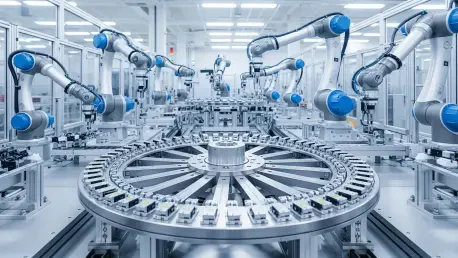
To meet these multifaceted demands, the engineering team devised a solution that expertly blended cutting-edge components from industry-leading suppliers with their own portfolio of proven, pre-engineered modules. The system’s operational core is a strategic combination of Yaskawa Motoman six-axis and high-speed SCARA robots, with each unit carefully selected for tasks that best suited its unique motion capabilities and payload capacity. These advanced robots work in perfect harmony alongside high-precision automatic screwdrivers and advanced machine vision systems that provide the critical “eyes” for the entire operation. The workflow itself is orchestrated around a proprietary rotary indexing ring, a heavy-duty steel platform whose clever open design allows for process modules to be efficiently placed both inside and outside its perimeter, maximizing the use of floor space and improving accessibility for maintenance and operation. This modular and integrated approach was instrumental in accelerating the implementation timeline.
The intricate assembly process is initiated with one of the system’s most intelligent and cost-effective features: vision-guided bin-picking. A sophisticated six-axis robot utilizes its integrated vision system to identify and accurately pick randomly oriented parts directly from a large supply bin, a capability that completely eliminates the need for expensive and labor-intensive part trays or specialized dunnage. In a remarkable display of efficiency, this same robot simultaneously retrieves different components from an innovative flex feeder positioned nearby. This adaptive feeding technology employs a small conveyor belt and an illuminated vision window to present a continuous and perfectly oriented stream of various parts to the robot. This allows for rapid changeovers between different part geometries without requiring any time-consuming mechanical adjustments, providing a level of flexibility that is essential for modern manufacturing environments where product mixes frequently change.
From Automated Assembly to Absolute Assurance
Once the initial components are successfully picked from both the bin and the flex feeder, the robot carefully places them into a custom-designed nest on the rotary indexing ring. As the ring methodically turns, the nascent assembly is transported through a meticulously planned sequence of automated stations. First, it arrives at a station where a custom-designed system precisely applies grease to multiple designated locations, a critical step for the product’s long-term performance. Following this, additional components are installed using a dynamic combination of methods: a human operator adds a part at the safeguarded manual loading station, a high-speed SCARA robot inserts another with exceptional speed, and several servo-driven, multi-axis pick-and-place units contribute the remaining pieces. In one of the final assembly steps, automated screwdriving and nutrunning systems engage from both above and below to install fasteners, a process that was expertly optimized by replacing slower pneumatic actuators with faster, more accurate servo-driven ones to meet the project’s demanding cycle time.
Before any assembly was deemed complete, it was subjected to a comprehensive series of rigorous electrical and mechanical verification checks to ensure total quality control and operational safety. This crucial final phase included a demanding 10-kilovolt hipot test, which meticulously confirmed the product’s electrical integrity and its full compliance with stringent industry safety standards. The culmination of this advanced engineering and integrated quality assurance was a system that not only met the client’s production targets but decisively shattered them. By achieving a sustained 94% efficiency rate and effectively doubling the throughput of the legacy equipment it replaced, the new automated line successfully eliminated the need for costly overtime. Moreover, it provided a constant stream of invaluable real-time performance data directly into the factory’s IIoT network, thereby fulfilling the client’s foundational vision of a truly data-driven smart factory.