
The latest software update from Ency introduces a suite of over 120 targeted changes, signaling a decisive move toward refining complex manufacturing workflows while simultaneously enhancing core stability and usability for its diverse user base. This release focuses on delivering more granular control over additive manufacturing processes, significantly broadening hardware compatibility for robotic automation, and implementing practical quality-of-life improvements. By addressing both high-level process optimization and foundational system performance, the update aims to create a more robust, efficient, and intuitive platform. This dual approach underscores a commitment to empowering specialists with advanced tools and ensuring a seamless, reliable experience for all users engaged in computer-aided design and manufacturing.
Revolutionizing Manufacturing Processes
The core advancements within this update are centered on redefining the capabilities of both additive and robotic systems. By introducing sophisticated new parameters and extending hardware support, the software empowers users to achieve unprecedented levels of precision and automation. These changes reflect a deep understanding of the evolving demands in modern manufacturing, where the integration of digital tools with physical machinery is paramount for achieving efficiency, quality, and innovation. The enhancements are not merely incremental; they represent a strategic push toward more intelligent and interconnected production environments, allowing for more complex tasks to be executed with greater reliability and control.
Enhanced Control in Additive Manufacturing
A pivotal development in the software’s additive manufacturing module is the introduction of a new “Power” parameter, which is now integrated into both Cladding 5D and Non-planar slicing operations. This feature provides users with direct, precise control over the energy input during the material deposition phase, a critical factor that dictates the quality of the final product. Previously, operators had to indirectly manage this by adjusting feed rates, a less intuitive and often less effective method. Now, by allowing direct manipulation of power, engineers can more effectively fine-tune the melt pool characteristics to optimize bead formation, improve layer adhesion, and ultimately achieve a superior surface finish. This level of control is essential for working with advanced materials and complex geometries where thermal management is a key challenge, transforming a once-approximate art into a more exact science.
Building upon this foundation of enhanced thermal management, the update also incorporates the ability to dynamically scale power when navigating corner regions of a part. This seemingly small adjustment addresses a persistent challenge in additive manufacturing where sharp turns and directional changes can lead to overheating, material buildup, and a degradation of surface quality. By intelligently reducing energy input in these critical zones, the software prevents material distortion and ensures a more uniform and aesthetically pleasing finish across the entire component. This feature is particularly beneficial for producing intricate parts with sharp angles or detailed features, where maintaining dimensional accuracy is non-negotiable. The combination of global power control and localized scaling provides a comprehensive toolset for mastering the nuances of non-planar deposition, elevating the potential for producing high-quality, functional parts directly from the digital model.
Expanding the Robotic Ecosystem
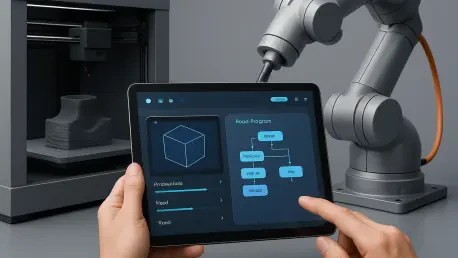
A major thrust of the recent update is the significant expansion of its robotic hardware support, which dramatically increases its integration potential within automated manufacturing cells. The software now includes native support for a host of new robot families, including Techman Robot, JHY, EVS, Hans Robot, HSR, and Fairino. This strategic broadening of compatibility opens the door for a wider range of businesses to adopt the platform, regardless of their existing robotic infrastructure. By removing hardware barriers, the software positions itself as a more universal and flexible solution for programming and controlling robotic arms in complex machining and fabrication tasks. This inclusivity is crucial for fostering a more connected and interoperable manufacturing landscape, allowing companies to leverage their current investments while adopting more advanced software capabilities for process optimization.
In addition to integrating new robot manufacturers, the update also delivers crucial updates to the existing library of supported brands, ensuring continued and improved compatibility with established industry leaders. The software now features enhanced support for robots from Omron, ABB, Aubo, Dobot, and Epson, among others. This commitment to maintaining and refining support for widely adopted hardware is just as important as adding new ones, as it provides long-term stability and confidence for a large segment of the user base. For manufacturers, this means that their existing robotic systems can now benefit from the latest software advancements without requiring a costly overhaul of their physical equipment. This dual strategy of embracing new technologies while reinforcing support for established ones ensures the platform remains a versatile and reliable hub for a diverse and growing ecosystem of automated manufacturing hardware.
A Focus on User Experience and Stability
Beyond the headline features for additive and robotic processes, a substantial portion of the development effort was dedicated to refining the user experience and fortifying the platform’s stability. These improvements address the everyday realities of design and manufacturing workflows, where efficiency and reliability are just as important as advanced capabilities. From streamlining technical support interactions to resolving long-standing bugs, the update reflects a comprehensive approach to software quality. This focus ensures that as the platform grows in complexity, its foundation becomes stronger, providing a dependable and user-friendly environment that minimizes friction and maximizes productivity for every engineer and operator.
Streamlining Everyday Workflows
One of the most practical enhancements is a complete redesign of the technical support message window, which directly addresses a common point of friction for users seeking assistance. The new interface now includes an integrated screenshot tool, allowing a user to capture a specific area of the application and have it automatically attached to their support ticket. This seemingly simple feature significantly streamlines the issue-reporting process, eliminating the cumbersome steps of using external screen-capture tools, saving files, and manually uploading them. By making it easier for users to provide clear, visual context for their problems, the new system not only improves the user experience but also enables the support team to diagnose and resolve issues more quickly and effectively, reducing downtime and frustration.
Further workflow refinements target specific machining scenarios to give operators greater flexibility and control. For instance, users can now selectively disable collision checking with fixtures for 2D Contouring and Hole machining operations. This is a highly requested feature for applications where drilling through a workpiece and into a sacrificial fixture plate is an intentional part of the process. Previously, the software would flag this as a collision, forcing workarounds or interrupting the workflow. Other subtle but impactful improvements include the ability to use arrow keys for navigation within the CL-data editor and the addition of updated smart hints and illustrations throughout the interface. These changes, while minor on their own, collectively contribute to a more intuitive, efficient, and less restrictive user experience, demonstrating a keen attention to the practical details of daily use.
A Comprehensive Platform Fortification
The release delivered a substantial overhaul of the software’s core stability and simulation accuracy, addressing a wide array of reported issues across the entire platform. Significant fixes were implemented for advanced toolpaths, including correcting errors in Non-planar slicing and Swarf operations that could lead to unpredictable machine behavior. The simulation engine received considerable attention, with improvements to overall performance, the elimination of false collision detections that previously halted valid programs, and a resolution to a bug that prevented the saving of simulation results. These enhancements are critical for ensuring that what users see on the screen accurately reflects what will happen on the machine, fostering greater confidence in the digital verification process and reducing the need for costly physical prototypes or test runs.
Project and system stability were also central to this comprehensive update, with a focus on preventing data loss and ensuring consistent performance. A critical fix was deployed to correct an issue where projects could not be restored after a software crash, a frustrating problem that could lead to significant lost work. Furthermore, errors related to saving projects directly to cloud services like OneDrive were resolved, improving compatibility with modern, distributed workflows. The update also tackled specific machine behavior anomalies, including errors in 4th-axis rotary operations, incorrect tool changes on mill-turn machines, and kinematic issues with Swiss-type lathes. This wide-ranging list of fixes, which also encompassed the CAD import module, user interface elements, and various add-ins, represented a thorough effort to fortify the platform from the ground up, making it a more reliable tool for mission-critical manufacturing.